
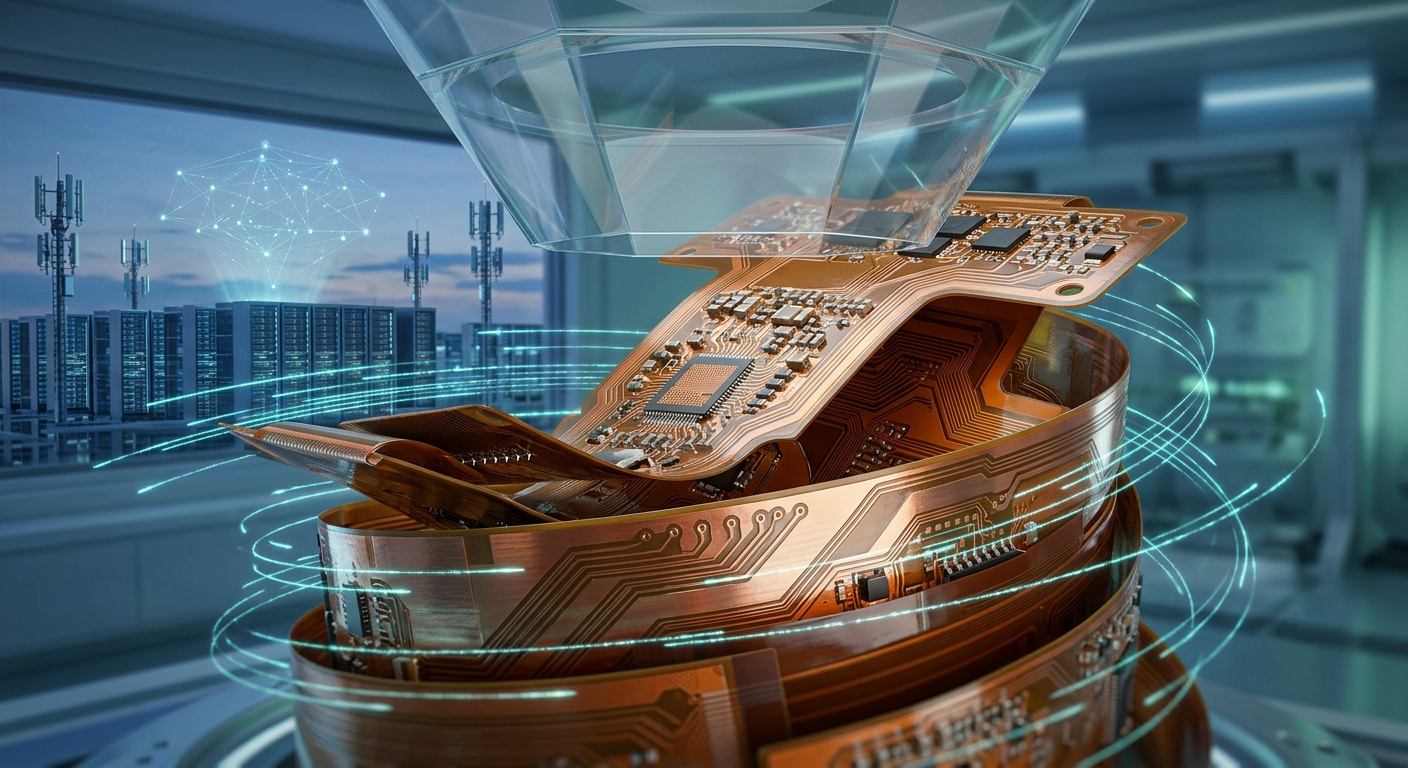
FPC Flexible Printed Circuit: The Ultra-Flexible "Nervous System" Shaping the Future of Hardware and Material Selection Strategies
Driven by the relentless demand for lighter, thinner, shorter, and smaller modern electronics—especially those featuring foldable and multi-dimensional bending designs—a pivotal hardware technology has emerged as the industry's ultimate "nervous system": the FPC (Flexible Printed Circuit, commonly known as the flex board).
If the rigid printed circuit board (RPCB) acts as the computing brain of an electronic product, the FPC is the vital nervous system that bridges independent modules, transmitting core electrical signals and power. This guide explores the engineering breakthroughs enabling smartphones, wearables, and electric vehicles (EVs) to push structural boundaries, alongside the essential component selection criteria.
1. What is an FPC? The 3D Structural "Flexible Skeleton" of Electronics
An FPC is a high-precision printed circuit board manufactured on high-performance polymer films, primarily Polyimide (PI) or Liquid Crystal Polymer (LCP). Unlike the uncompromising, rigid architecture of traditional PCBs, FPCs introduce revolutionary physical properties that redefine Design for Manufacturability (DFM):
-
Ultimate Dynamic Flexibility: FPCs can be freely bent, folded, and rolled in three dimensions without compromising the electrical performance of the conductive traces over long-term deformation cycles.
-
Extreme Thinness and Space Compression: Featuring an ultra-thin profile, FPCs eliminate the vertical blind spots associated with traditional wire harnesses, saving critical, high-value internal enclosure space.
-
High-Density and Fine Line/Space Routing: Capable of executing intricate parallel circuit routing within micron-scale trace spacing.
2. Why is it the "Ultimate Nervous System" in Hardware Architecture?
FPC's status as a cornerstone of highly integrated modern electronics stems from its fundamental ability to resolve two major hardware engineering pain points: space compression and dynamic motion connectivity.
(I) 3D Routing and Ultra-High Dynamic Flex Life
1.The Ultimate Space Saver: Breaking the Planes with 3D Assembly
(1)Traditional rigid board routing is confined to a two-dimensional plane. FPCs, however, conform effortlessly to the contours of a product's inner enclosure and snake around tight, non-linear junctions.
(2)This adaptability is precisely how modern smartphone periscope camera modules and multi-dimensional sensor arrays fit inside ultra-narrow bezels.
2.Dynamic Connectivity: The Physical Lifeline of Foldable Devices
(1)In the mechanical architecture of foldable phones and slider devices, the hinge’s U-shaped slot must withstand hundreds of thousands of opening and closing cycles.
(2)FPCs engineered with Rolled-Annealed (RA) Copper possess superior microscopic crystalline ductility. This exceptionally high dynamic flex life ensures that high-frequency display signals maintain stable impedance matching despite continuous, repetitive mechanical stress.
3. Four Core Applications and Material Specifications of FPCs
As manufacturing processes evolve, FPCs have expanded far beyond consumer electronics, capturing high-specification, high-margin opportunities in the automotive and medical sectors:
(II) Cross-Domain Hardware Functionality and Environmental Adaptability
|
Core Application |
Key Hardware Function & Internal Routing |
Core Process & Material Requirements |
|---|---|---|
|
Consumer Electronics |
Smartphone OLED display ribbons, compact camera module (CCM) interconnects, and side-mounted pressure-sensitive buttons. |
Demands ultra-fine trace widths (under 20μm); heavily relies on the mSAP process to maximize SMT yields. |
|
Wearable Devices |
Annular (ring-shaped) routing inside smartwatches, and lightweight bridge interconnects between the main and sub-boards of AR/VR headsets. |
Emphasizes extreme 3D flexibility, high-temperature resistance, and skin-friendly compliance; frequently integrates ultra-miniature Board-to-Board (BTB) connectors. |
|
Automotive Electronics |
Battery Management System (BMS) sampling harnesses for power batteries, LiDAR arrays, and automotive vision cameras. |
Completely replaces heavy, traditional copper wire harnesses; requires high voltage resistance, chemical corrosion immunity, and vibration damping. |
|
Medical Devices |
Disposable electronic endoscopes and implantable micro-physiological sensors. |
Pairs microscopic footprints with stringent biocompatibility testing and medical-grade certifications. |
4. Conquering High-Speed Transmission: The Next Frontier of FPC Engineering
While FPCs are remarkably versatile, the massive influx of high-frequency, high-speed data transmission and highly integrated edge devices is driving a profound technological evolution within the flex board industry:
1.The Shift to High-Frequency, High-Speed Substrates (LCP & MPI)
(1)To handle blistering data transfer rates, electromagnetic waves traveling through traditional PI substrates encounter substantial dielectric loss, causing signal attenuation and thermal issues.
(2)To preserve Signal Integrity (SI), premium FPCs must transition to Liquid Crystal Polymer (LCP) or Modified Polyimide (MPI) substrates, which offer extremely low dielectric constants (Dk) and near-zero moisture absorption.
2.Manufacturing Approaches Semiconductor-Level Precision
(1)As circuit spacing shrinks to micron levels, traditional chemical etching (subtractive manufacturing) can no longer deliver the trace edge straightness required. Factories are adopting modified Semi-Additive Processes (mSAP) and Semi-Additive Processes (SAP), lifting cleanroom standards to levels reminiscent of semiconductor foundries.
3.Green Supply Chains and Sustainability
(1)With international environmental regulations (RoHS/REACH) tightening, developing halogen-free flex substrates that are easily recyclable, low-carbon, or biodegradable—while maintaining absolute resistance to high-temperature lead-free reflow soldering—is paramount for long-term supply chain resilience.
5. Professional Q&A: FPC Engineering in Practice
Q1: During early-stage hardware development, how should an FPC be designed with a shielding film for high-frequency signal transmission to prevent EMI failures?
A: In high-speed, high-frequency transmission (such as high-speed MIPI display lines or RF signals), the FPC can easily become an EMI emitter or victim. Designers must laminate specialized silver paste or silver-nanowire EMI Shielding Films to the outer layers of the FPC. This film connects to the FPC's ground line (GND) at multiple points via conductive adhesive, creating a Faraday cage effect similar to a rigid PCB's metal shield. This setup effectively blocks internal noise leakage and protects adjacent, sensitive RF chips from interference.
Q2: When designing a "Rigid-Flex PCB," how do you prevent traces from cracking or snapping at the junction where the FPC meets the RPCB?
A: This is a classic failure mechanism caused by stress concentration. At the transition area between the rigid and flexible materials, the massive discrepancy in elastic modulus causes solder joints and traces to experience micro-cracking under repetitive bending due to shear stress. To optimize your DFM layout, specify a Polyimide (PI) Stiffener on the FPC side of the transition area. Structurally, the transition boundary line should follow a curved, non-linear path. Furthermore, copper traces in this zone must never use 90∘ right-angle bends; they must transition via smooth arc routing to evenly distribute mechanical stress.
6. Conclusion
With its unique ability to conquer rigid structural challenges through flexibility, the FPC serves as the hidden backbone of today's highly integrated tech landscape. It is far more than a thin, pliable circuit; it is the fundamental nervous system that enables next-generation industrial design.
For procurement and hardware R&D teams marveling at the sleek compactness of cutting-edge devices, deep-diving into the physics and material science powering this "ultimate nervous system" is the only definitive way to guarantee absolute connection reliability in the most demanding environments.