
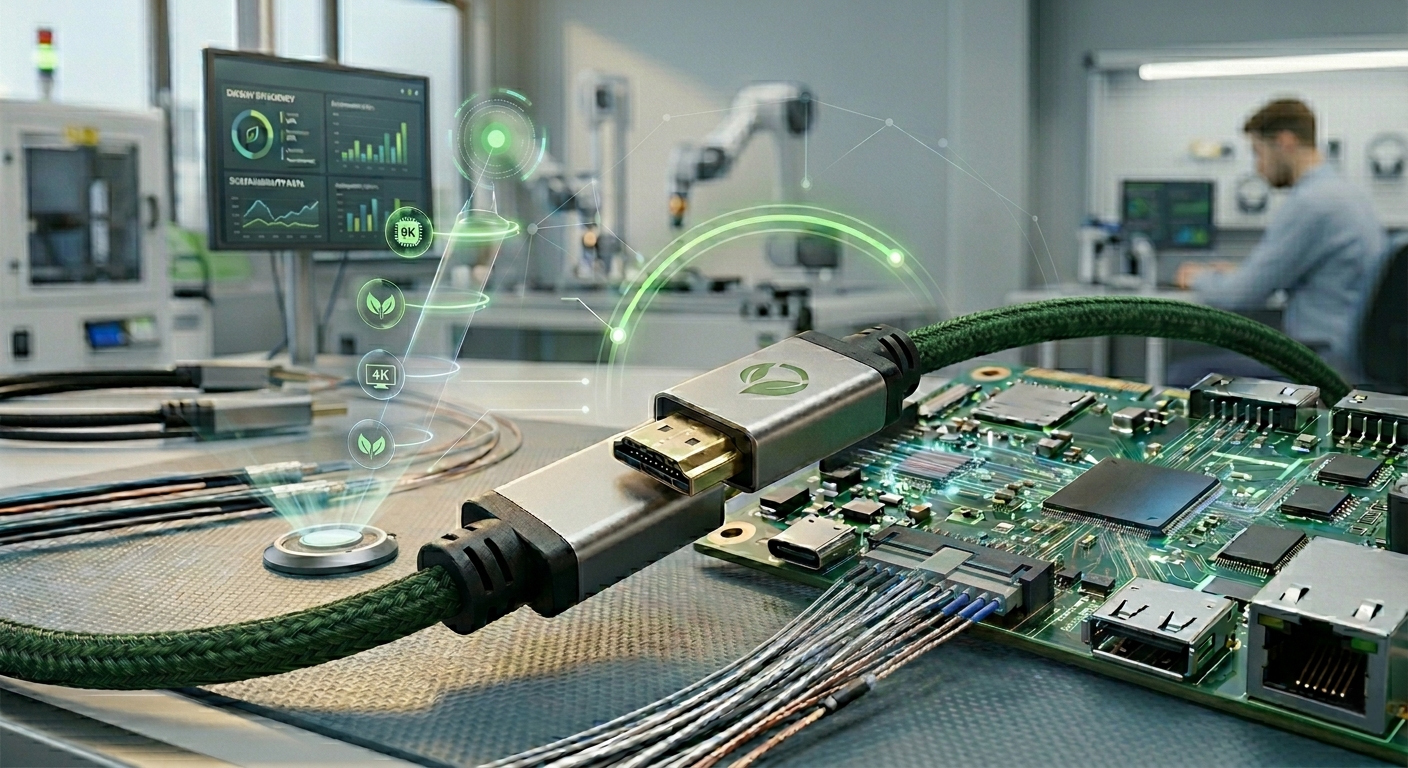
From Precision Connectivity to a Sustainable Future: Analyzing Electronic Connection Solutions and HDMI Evolution Under the ESG Wave
If you have ever wondered why, after upgrading to an expensive 4K TV or a PS5, you still experience perceptible lag or cannot enable the highest HDR specifications, the culprit is often not your display hardware—it is that unassuming HDMI (High-Definition Multimedia Interface) cable.
Since its debut in 2002, HDMI has undergone multiple technological iterations. In today's era of booming demand for ultimate audio-visual experiences, the bandwidth upgrade of each generation directly dictates the technical ceiling of your living room's picture quality and operational smoothness.
1. The Evolution of HDMI Versions: Bandwidth Dictates Everything
The generational differences in HDMI fundamentally come down to a race for data transmission speeds. The larger the bandwidth, the higher the resolution and refresh rate (Hz) it can support.
1.HDMI 1.4: The Stepping Stone to 4K (Released in 2009)
This is the standard specification for many older laptops and Full HD TVs.
-
Performance Ceiling: Supports 4K resolution, but the refresh rate maxes out at 30Hz.
-
Technical Pain Point: At 30Hz, fast-moving sports movies or video games will exhibit noticeable motion blur and stuttering. Today, this is considered an obsolete, entry-level standard.
2.HDMI 2.0: The Golden Standard for Fluid 4K Audio-Visuals (Released in 2013)
Currently the most prevalent version on the market, it nearly doubled the bandwidth from 10.2Gbps to 18Gbps.
-
Core Evolution: Fully supports 4K@60Hz and HDR technology, elevating color depth to 10-bit.
-
Application Scenarios: Netflix 4K streaming, standard home consoles, and typical office monitor configurations.
3.HDMI 2.1: Ultimate Gear for Hardcore Gamers and 8K Home Theaters (Released in 2017)
Representing the current pinnacle of HDMI technology, its bandwidth skyrockets to 48Gbps, making it a critical cornerstone for the future smart home.
-
Performance Ceiling: Supports 4K@120Hz and even 8K@60Hz ultra-high-definition transmission.
-
Flagship Features:
-
VRR (Variable Refresh Rate): Eliminates screen tearing; a must-have for PS5 and Xbox Series X gamers.
-
eARC (Enhanced Audio Return Channel): Supports lossless transmission of premium audio formats like Dolby Atmos.
-
ALLM (Auto Low Latency Mode): Automatically triggers the display's low-latency gaming mode.
-
2. Navigating the Consumer Trap: Look Beyond the Numbers, Check the "Certification Label"
Many consumers impulsively buy a cable at the store just because the packaging claims it "Supports 8K," only to find out it cannot output 120Hz at home. This occurs because the HDMI Forum allows manufacturers to label products as HDMI 2.1 as long as they comply with some of its features, leading to significant market information asymmetry.
Professional Guide to Avoiding Traps
-
Look for the Holographic Anti-Counterfeiting Label: When purchasing an authentic HDMI 2.1 cable, the packaging must feature a colored QR code anti-counterfeiting label that reads "Ultra High Speed HDMI".
-
Physical Length and Signal Degradation: Traditional copper HDMI cables suffer from severe signal degradation beyond 5 meters. For long-distance transmission (such as home theater projectors), it is highly recommended to select active cables or AOC (Active Optical Cable) HDMI solutions.
-
The Hardware "Barrel Effect" (Bottleneck): Your ultimate video quality depends on the lowest common denominator among your Output Device + Cable + Display. If your TV only supports HDMI 2.0, even using an HDMI 2.1 cable will not unlock 120Hz performance.
3. Sustainable Choices Under the ESG Wave: The Eco-Friendly Value of Premium Connectors
Under the global wave of ESG (Environmental, Social, and Governance), high-quality electronic connection solutions do more than just deliver sensory enjoyment—they possess deep sustainable value:
-
High Durability Reduces Electronic Waste: Choosing certified HDMI cables with robust braided jackets and thick gold plating significantly extends their lifespan, cutting down on cable waste caused by premature wear and tear.
-
Stable Power and Data Transmission: Premium cables offer superior shielding to minimize Electromagnetic Interference (EMI), ensuring devices achieve optimal performance output with minimum energy consumption.
Professional Q&A: Troubleshooting HDMI Tech Applications
Q1: If I only watch standard TV programming, is it necessary to upgrade to HDMI 2.1?
A: If your needs are strictly limited to 1080p or 4K@60Hz video content, HDMI 2.0 is more than adequate. However, if you plan to upgrade to next-gen consoles (like the PS5 Pro) or use high-end soundbar systems in the future, going straight for an HDMI 2.1 (Ultra High Speed) cable offers much better future-proofing.
Q2: Do HDMI cables marketed with "Gold Heads" or "Gold Plating" actually improve picture quality?
A: The primary function of gold plating is to resist oxidation and maintain stable contact resistance. In long-term humid environments, gold-plated connectors prevent poor contact. While it won't magically transform a 1080p picture into 4K, it ensures that digital signals are precisely transmitted over years of use.
Q3: What is the difference between an Optical Fiber HDMI cable (AOC) and a traditional copper cable?
A: Optical HDMI utilizes light signals for transmission, offering zero latency, immunity to electromagnetic interference, and virtually no signal attenuation. When transmitting 4K@120Hz or 8K signals over long distances (exceeding 10 meters), fiber optic cables are the only stable solution capable of guaranteeing full bandwidth integrity.
Cables Are the "Last Mile" of Audio-Visual Quality
Choosing the correct version of an HDMI cable does more than just unleash the full performance of your hardware—it reflects a commitment to a sustainable lifestyle. In the journey of connecting our smart lives, these tiny metal contact points and cable technologies serve as the most critical bridges to the ultimate sensory experience.