
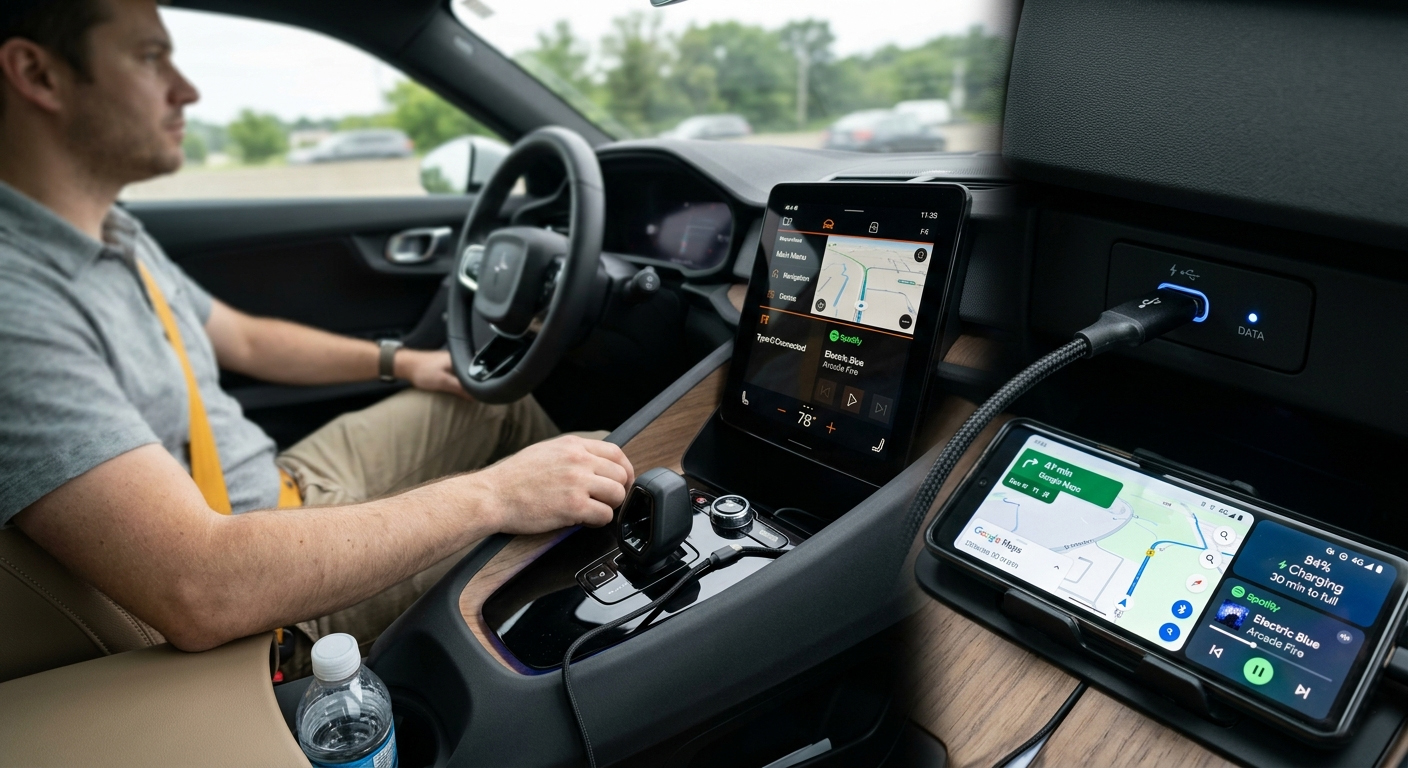
Beyond Fast Charging: Understanding the Four Core Roles of USB Type-C in Automotive Electronics
With the automotive industry pivoting towards Software-Defined Vehicles (SDV) and electrification, the USB Type-C (Type-C) interface has evolved into a vital standard for power delivery and high-speed communication in modern vehicles. Leveraging high-bandwidth Power Delivery (USB-PD) and ultra-fast data transfer, Type-C has become a cornerstone of the Smart Cockpit. Below is a technical analysis of the four core applications of Type-C in the automotive sector and the engineering logic behind them.
1. High-Power Automotive Charging (USB-PD): The Mobile Office Solution
Compared to the traditional USB-A ports with limited output, the USB-PD (Power Delivery) protocol integrated into Type-C has revolutionized the in-car charging experience for passengers.
■ Rapid Charging & Smart Power Allocation
Through PD 3.1 and advanced standards, automotive Type-C ports can deliver 60W, 100W, or even up to 240W. This is sufficient to fast-charge not only smartphones but also power-hungry laptops during a commute. Professional automotive charging modules feature intelligent power allocation, automatically adjusting current based on the device's battery state to ensure thermal safety and efficiency.
■ Ecosystem Unification
The ubiquity of Type-C eliminates the need for multiple adapters. A single E-Marker cable can handle everything from high-fidelity audio to high-wattage power, significantly reducing clutter within the cabin.
2. High-Speed Data Transfer & Multimedia Infotainment Streaming
As In-Vehicle Infotainment (IVI) systems demand 4K or 8K video synchronization, the high-speed data link provided by Type-C has become the preferred choice for system integrators.
■ Seamless Smartphone Integration & Low-Latency Connectivity
For Apple CarPlay and Android Auto users, Type-C’s USB 3.2 or USB 4.0 specifications ensure lag-free navigation maps and lossless audio streaming. This is critical for intelligent navigation systems that process massive amounts of map data and voice commands in real-time.
■Over-the-Air (OTA) Updates & Diagnostics
In service environments, the Type-C port serves as a high-bandwidth physical entry point for Firmware Over-the-Air (OTA) updates and vehicle diagnostics. Technicians can flash systems rapidly, significantly reducing service turnaround times.
3. ADAS Internal Connectivity & Spatial Optimization
Within the vehicle's internal circuitry, the Small Form Factor of Type-C provides a competitive edge in confined interior spaces.
■ Sensor and Dash Cam Integration
Modern vehicles are equipped with numerous cameras and sensors. Type-C interfaces are increasingly used to connect Dash Cams or in-cabin monitoring cameras, ensuring that high-frame-rate video data is transmitted reliably to the Electronic Control Unit (ECU).
■ Mechanical Flexibility in Cabin Design
The reversible nature of Type-C and its minimal PCB footprint allow industrial designers to plan more compact layouts in center consoles, armrests, or headrests. This also simplifies Wire Harness routing by reducing the bulk of traditional automotive connectors.
4. Rigorous Standards: Designing Automotive-Grade Type-C Connectors
The fundamental difference between automotive and consumer-grade Type-C lies in "Extreme Reliability." To enter the automotive supply chain, components must pass stringent quality benchmarks.
■ Thermal Durability and Vibration Resistance
Automotive-grade connectors must comply with IATF 16949 and AEC-Q certifications. They must operate reliably between -40°C and 105°C. To withstand constant vehicle vibrations, these connectors feature enhanced contact pressure and locking mechanisms to prevent signal discontinuity.
■ EMI / EMC Shielding Integrity
Vehicles are saturated with wireless signals from radar, Bluetooth, and Wi-Fi. Professional-grade automotive Type-C connectors must feature full-metal shielding to prevent Electromagnetic Interference (EMI) from affecting critical autonomous driving sensors or communication systems.
Technical Q&A: Common Concerns Regarding Automotive Type-C
Q1: How does an automotive Type-C port resist corrosion in humid cabin environments?
A: Automotive-grade ports typically use thick gold plating on terminals and high-temperature LCP plastic bodies. Many also incorporate gasket seals to achieve IPX7 ratings, protecting against liquid spills and electrochemical corrosion.
Q2: Can any Type-C cable trigger 100W charging in a car?
A: Not necessarily. For power delivery above 60W, a cable with a built-in E-Marker chip is required, and both the charger module and the device must support the corresponding PD profile.
Q3: Why is there such a significant price gap between automotive and consumer Type-C connectors?
A: The cost stems from material science and certification overhead. Automotive products use high-performance alloys and durable mechanical structures that undergo months of reliability testing to ensure a service life of 10+ years.