
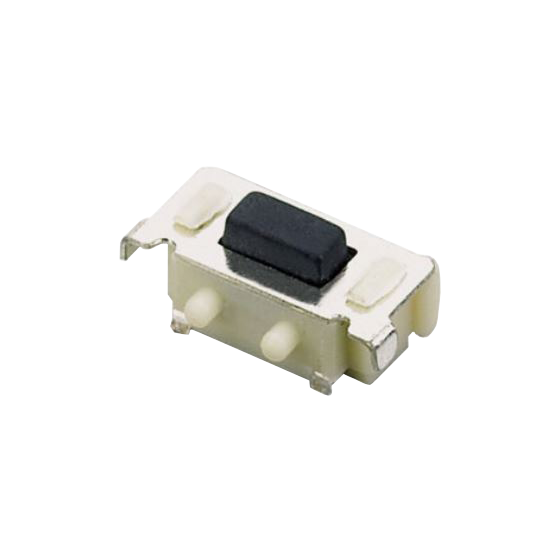

Tactile Switch: Overview and Working Principle
A tactile switch (or tact switch) operates through an internal metal dome that deflects under operating force to close the circuit. Once the force is released, the dome snaps back to its original shape, and the switch returns to its open state.
Product Structure
The switch is composed of five key components:
- Terminals: Electrical connection points.
- Base: The main housing body.
- Metal Dome (Contact): The moving part that enables connectivity.
- Stem (Button): The part pushed by the user.
- Cover: The protective top plate.
Common Classifications
■ Mounting Types: Available in SMD (Surface Mount Device) and DIP (Through-hole).
■ Orientations: Includes Vertical (top-actuated) and Horizontal (side-actuated/right-angle) designs.
■ Variations: They come in a wide range of sizes and specifications, making them one of the most versatile and frequently used electronic components in daily life.
■ Orientations: Includes Vertical (top-actuated) and Horizontal (side-actuated/right-angle) designs.
■ Variations: They come in a wide range of sizes and specifications, making them one of the most versatile and frequently used electronic components in daily life.
Applications
Tactile switches are commonly used to control the power functions (ON/OFF) of various electronic products, such as:
■ Medical Equipment
■ Mobile Phones
■ Remote Controls
 Join our official LINE for immediate inquiries.
■ Mobile Phones
■ Remote Controls
Join our official LINE for immediate inquiries.