
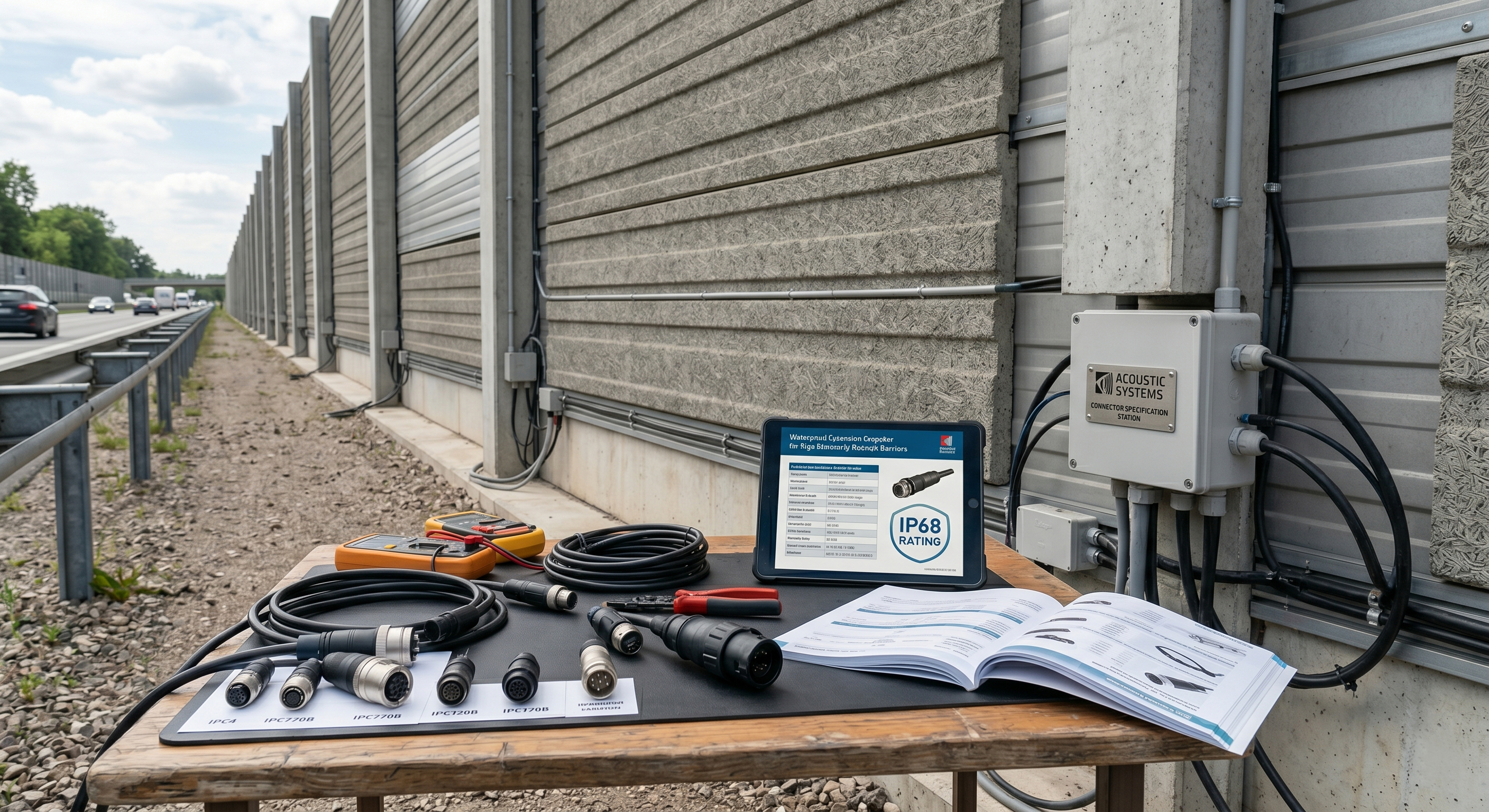
The Silent Barrier of High Reliability: Sourcing the Optimal Waterproof Connector Architecture for Noise-Abatement Systems
In today’s residential and commercial spaces that demand extreme tranquility and high-end automation, "silent barriers" (such as active noise-canceling acoustic walls, precision automated motorized blinds, and ultra-quiet outdoor ventilation louvers) are playing a highly prominent role. To maintain long-term system stability in outdoor, coastal, or volatile weather conditions, their highly integrated Electronic Control Units (ECUs), precise data sensors, and drive motors rely heavily on an unsung hero: the waterproof connector. If a connector suffers fluid ingress, it can trigger localized signal noise (a terminal defect for noise-sensitive acoustics) or lead to catastrophic electrical short-circuits. This comprehensive guide outlines how to source the perfect waterproof interconnect architecture for high-reliability acoustic barrier systems.
I. Identifying the Liquid Environment: Evaluating International IP Sealing Standards
The initial phase of choosing a waterproof connector involves defining the precise severity of fluid and moisture exposure the system will confront during field service. The international standard utilizes the Ingress Protection (IP Rating) metric to establish physical boundaries:
(I) Splash and Temporary Immersion Parameters
- IP65 / IP66 (Water Jets and Heavy Seas Protection)
(1) This rating is optimized for acoustic systems deployed under outdoor canopies or structures exposed only to wind-driven rain and low-pressure maintenance washdowns (e.g., automated motorized louvers on architectural facades).
- IP67 (Temporary Submersion Resilience)
(1) This profile handles complete submersion in water up to 1 meter deep for a standard 30-minute duration.
(2) For acoustic equipment frequently exposed to seasonal downpours, flash floods, or units installed near low-lying grade levels, an IP67 rating serves as the foundational hardware baseline.
(II) Continuous Submersion and Dynamic Jet Washdowns
- IP68 / IP69K (Extreme Environmental Hermetic Sealing)
(1) If your sub-assembly is deployed in high-humidity coastal zones or requires aggressive, automated cleaning using high-pressure steam jets (such as food processing enclosures or special medical barriers), deploying an IP68/IP69K paired solution is mandatory to combat fluid tracking caused by the capillary siphoning effect.
II. Eradicating Micro-Vibrations: Mandating Robust Mechanical Locking Interfaces
While a silent barrier targets total acoustic tranquility, its internal motor drive circuits, along with external wind loads and passing vehicular traffic (in the case of highway noise barriers), continuously subject the chassis to low-frequency structural harmonics. Over time, these continuous micro-vibrations can cause standard friction-fit interfaces to back out, displacing internal rubber gaskets and letting moisture seep in.
(I) Industrial-Grade Coupling Mechanics
- Threaded Locking Couplers
(1) The most traditional and reliable configuration. Threaded metal or high-tensile polymer couplings rigidly lock the plug and receptacle together, providing exceptional pull-force strain relief and vibration dampening.
- Bayonet Locking Systems
(1) Requiring only a quick quarter-turn to lock securely into place, bayonet mechanisms combine excellent mechanical vibration resistance with fast tool-less handling for routine field diagnostics.
- Push-Pull Self-Locking Mechanisms
(1) While providing exceptional mating throughput, push-pull structures must be verified against rigorous industrial sweep-frequency vibration standards before deployment in heavy high-wind outdoor environments.
III. Material Selection Dictating System Lifespan: Resisting UV Degradation and Salt-Fog Corrosion
Premium noise-abatement barriers are engineered for operational lifespans spanning 5, 10, or more years. When left exposed to the elements, intense solar ultraviolet (UV) radiation and airborne marine salt-fog represent the primary catalysts for connector failure.
(I) Material Science of the Outer Shell and Seals
- Enclosure Resin Selection Matrix
(1) Engineered Resins: Plastic shells must be molded from flame-retardant polymers infused with specialized UV stabilizers (such as premium weatherized PA66 or PBT). Unprotected plastics will exhibit micro-cracking and embrittlement within a few seasons, causing the structural seal to fail.
(2) Metal Shells: For applications prone to heavy mechanical impacts, specify corrosion-resistant passivated stainless steel (SUS316) or high-grade aluminum alloys treated with thick hard-coat anodization or specialized anti-corrosion platings.
- Elastomeric Gasket (O-Ring) Integrity
(1) The O-ring serves as the core physical shield against moisture ingress. Choosing Viton (fluorocarbon) or high-grade Silicone rubber guarantees excellent compression set resistance and thermal stability across extreme temperature windows, validating true DFM longevity principles.
IV. Aligning Electrical Profiles with High-Frequency Signal Integrity
High-reliability silent barriers cannot tolerate localized signal dropouts. Sourcing teams must precisely match connector pins with technical electrical parameters:
(I) Coexistence of Heavy Power Rails and Sensitive Logic
- The Core Advantages of Hybrid Connector Architectures
(1) Actuator drive motors demand high current capacities (Power), whereas adjacent environmental sensors require low-noise, low-voltage communication paths (Signal).
(2) To optimize internal PCBA space and streamline chassis cable routing, implementing a hybrid ("Power + Signal" consolidated) connector is highly recommended. This collapses multiple cables into a single bundle, minimizing the number of enclosure cutouts. Fewer chassis openings directly mathematically reduce potential leak paths.
(II) Electromagnetic Compatibility (EMC/EMI) Shielding Effectiveness
-
Suppressing High-Frequency Noise Leakage
(1) Modern automated silent barriers house precise logic processing chipsets or high-frequency wireless arrays.
(2) A connector assembly outfitted with a 360º metal shielding cage insulates the interior conductors from ambient electromagnetic interference. This keeps data transmissions pristine, preventing control logic corruption that could trigger unintended motor jitter or mechanical acoustic buzzing.
V. Waterproof Connector Selection Checklist for High-Reliability Silent Barriers
|
Evaluation Metric |
Recommended Engineering Specification / Standard |
|
Ingress Protection (IP) |
Baseline IP67 for standard outdoor deployments; upgrade to IP68 / IP69K for marine or high-pressure steam environments. |
|
Mechanical Coupling |
Prioritize Threaded Locking or Bayonet Locking couplers; strictly ban friction-only configurations in vibration zones. |
|
Material Formulation |
UV-stabilized engineered resins (PA66/PBT) or hard-anodized metal alloys, backed by Viton or Silicone O-rings. |
|
Pin Configuration |
Implement consolidated Hybrid (Power + Signal) architectures to optimize enclosure cutout counts. |
|
Global Compliances |
Mandate full third-party certifications including UL, CE, RoHS, alongside specialized vibration and Salt Spray testing data. |
VI. Professional Technical Q&A: Silent System Waterproof Selection Insights
Q1: Do internal motor startup thermal cycles compromise the long-term sealing performance of a connector's O-ring?
A: Yes. Thermal cycling induces internal air expansion and contraction, which alters the delta pressure inside the sealed enclosure. Component engineers must ensure the connector's operating temperature envelope accommodates these peaks. Additionally, integrating a waterproof, breathable protective vent into the enclosure chassis balances internal gas pressures while blocking external fluids, preserving the O-ring from pressure-induced mechanical deformation.
Q2: Is it safe to deploy original-equipment-manufacturer equivalent (OEM Alternative) waterproof connectors to optimize BOM costs?
A: Sourcing premium equivalent components is a standard, highly effective supply chain strategy. As long as the equivalent option matches the original component's polymer metrics (UV resistance class), plating thicknesses, and third-party IP verification metrics on its technical datasheet—and successfully passes rigid incoming quality control (IQC) pull-force and hermeticity trials—adopting a qualified alternative safely optimizes your product bill-of-materials.
When planning waterproof interconnect configurations, the overriding principle is "prevention is more economical than field remediation." Allocating appropriate capital early in the design cycle toward high-performance ingress protection ratings, mechanical locks, and robust materials protects your silent barrier hardware from expensive field engineering repairs, firmly anchoring your brand equity and customer trust.