
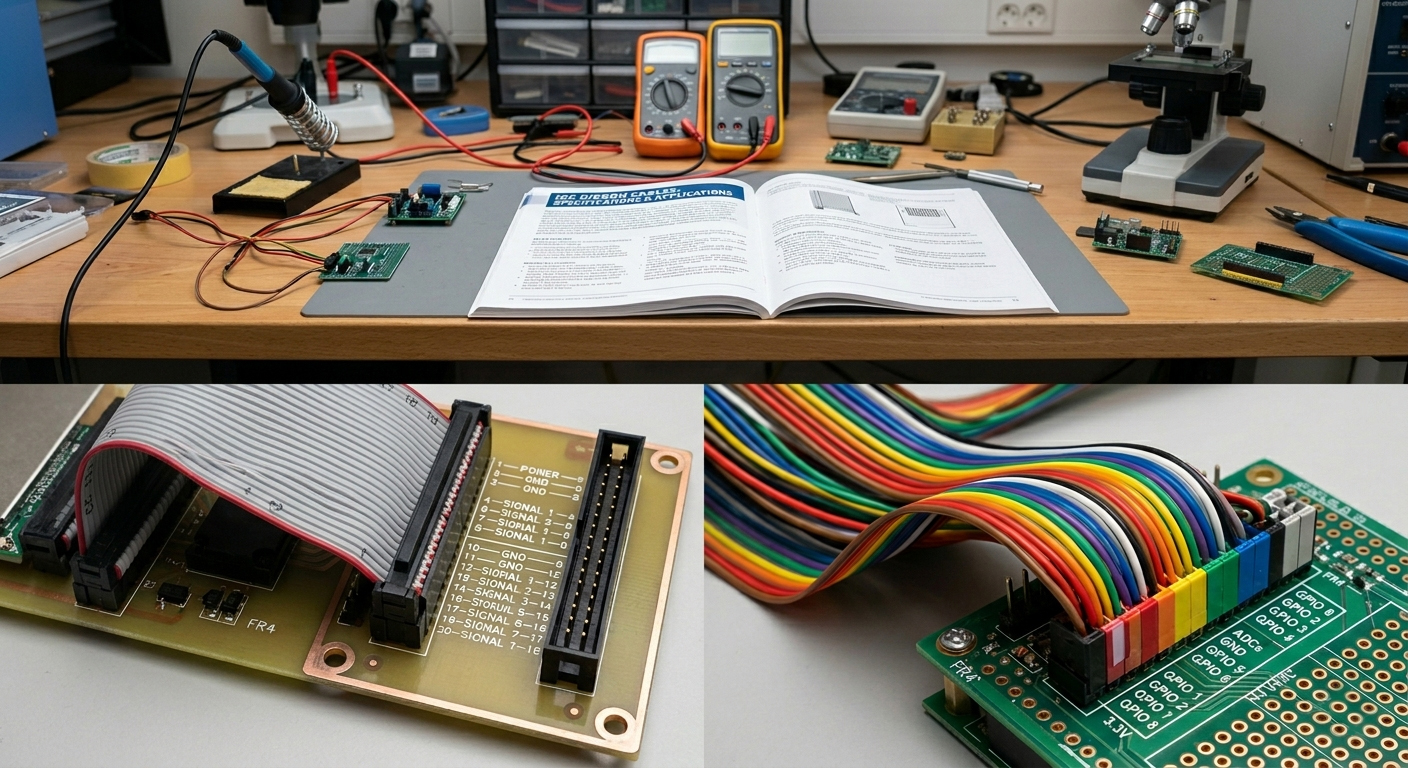
Gray vs. Rainbow Flat Cable: Deconstructing Specifications, Manufacturing Standards, and Application Differences
In the world of electronics manufacturing and wire harness processing, Gray Flat Cable and Rainbow (Color) Flat Cable are the most essential multi-conductor cables, typically paired with IDC (Insulation Displacement Connectors). While they share similar electrical architectures, they offer distinct advantages in terms of automated assembly, maintenance accessibility, and internal layout optimization.
1. Gray Flat Cable: The Standard for Professional Efficiency
Gray flat cable is characterized by its uniform gray PVC jacket with a distinct red stripe along one edge to identify Pin 1. This visual marker is critical for maintaining polarity during the IDC crimping process.
■ Core Scenarios in Industrial and Commercial Sectors
Industrial Control & Automation: Widely utilized for PLC modules and Industrial PCs (IPC). Its standardized nature makes it the go-to choice for large-scale OEM projects where consistency is paramount.
Embedded Systems: Essential for connecting development boards like Raspberry Pi or Arduino to peripherals such as LCD modules or sensor arrays.
Business Equipment: Found in the internal assemblies of multi-function printers and copiers, bridging the gap between the main logic board and the scanner unit.
■ Key Advantages: Cost-Effectiveness and Clean Aesthetics
Gray flat cables offer a lower cost per meter, making them ideal for high-volume production. Inside a device, the single-tone color provides a professional, organized look, preventing the internal wiring from appearing cluttered.
2. Rainbow Flat Cable: Superior Identification and Repairability
Rainbow flat cables utilize a color-coding system (typically following the international resistor color code: Black, Brown, Red, Orange, Yellow, Green, Blue, Violet, Gray, White).
■ Applications Focused on Complex Systems and Maintenance
Prototyping & R&D Debugging: During the development phase, engineers must track specific signals across a dense board. Color-coded wires allow for instant visual verification against schematics without relying on a multimeter.
Point-to-Multipoint Harnesses: When a single ribbon cable must be split to connect to multiple targets, colors ensure that technicians avoid miswiring during assembly or field repairs.
Precision & Medical Instrumentation: In high-stakes environments where human error must be minimized, the color-layered design reduces worker fatigue and assembly mistakes.
■ Physical Feature: The "Zip Type" Flexibility
Rainbow cables are often designed to be easily "zipped" or torn apart by hand. This allows a 10-pin cable to be precisely divided into 2-pin or 4-pin segments, offering immense flexibility for robotic joints or custom routing.
3. Specification Comparison: Gray vs. Rainbow
|
Feature |
Gray Flat Cable |
Rainbow Flat Cable |
|
Visual Focus |
Clean, Pin 1 Red Stripe Indicator |
Color-coded, Individual Wire Recognition |
|
Pitch (Spacing) |
Primarily 1.27mm (fits 2.54mm IDC) |
Available in 1.0mm, 1.27mm, 2.54mm |
|
Conductor Size |
Mostly 28 AWG Tinned Copper |
Ranges from 26 AWG to 30 AWG |
|
Primary Purpose |
Standardized mass production |
Identification, easy splitting, and maintenance |
|
Standards |
UL2651 Compliance |
UL2651 Compliance |
[Image showing the process of crimping an IDC connector onto a flat ribbon cable]
Technical Q&A: Choosing the Right Ribbon Cable for Your Project
Q1: What is the most common cause of poor contact after IDC crimping?
A: Pitch mismatch is the leading cause—for example, attempting to press a 1.27mm cable into a 1.0mm connector. Additionally, uneven cable cuts (burrs) can prevent the IDC blades from accurately piercing the center of the conductor, leading to high contact resistance.
Q2: How should I choose the right AWG for my ribbon cable?
A: 28 AWG is the industry standard for general data transmission. However, if your application involves power delivery (such as driving small stepper motors), consider 26 AWG for its thicker conductors to minimize voltage drop.
Q3: Is there a difference in EMI performance between Gray and Rainbow cables?
A: Both are unshielded designs with similar EMI profiles. If your device must pass strict EMC certifications, consider using shielded gray flat cables (jacketed with aluminum foil) or adding ferrite cores to suppress high-frequency noise.