
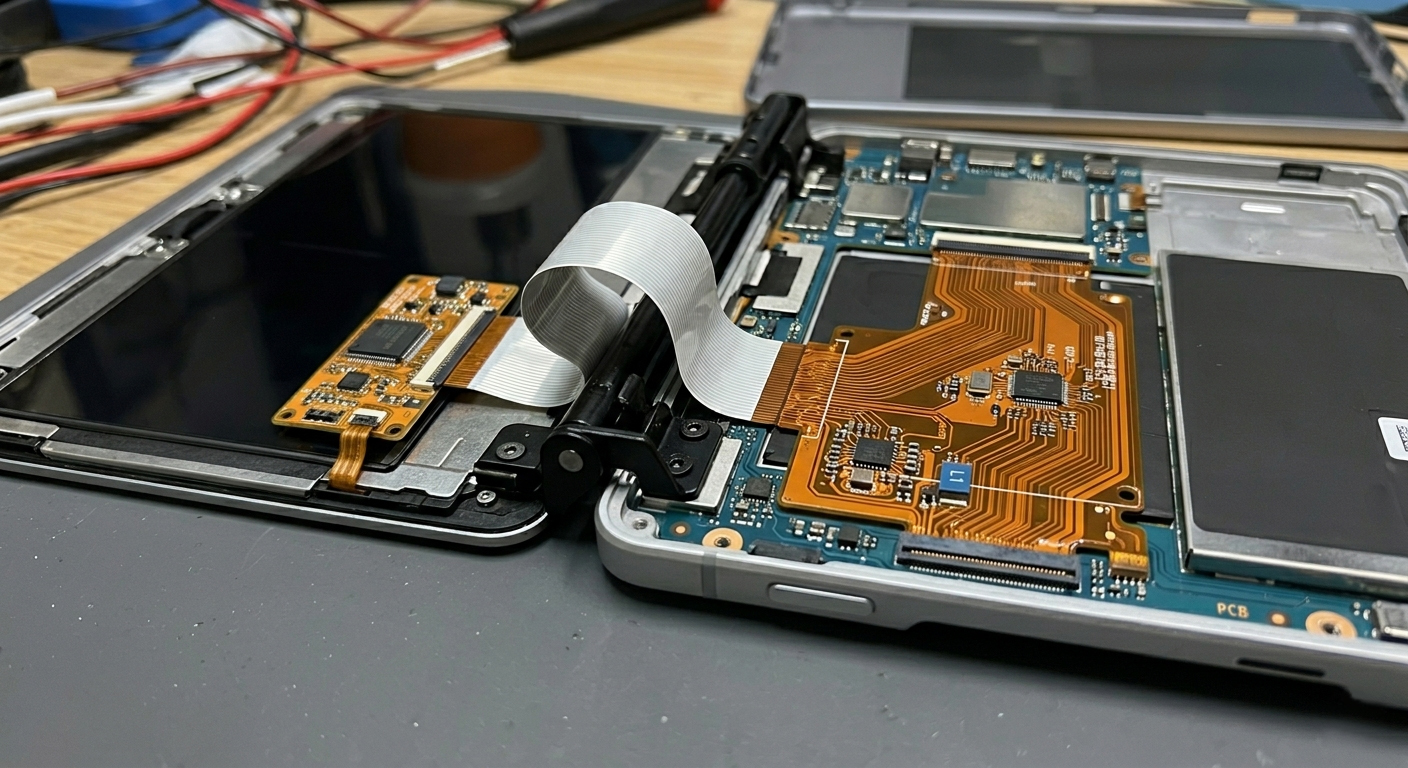
FFC vs. FPC: A Deep Dive into the "Static" and "Dynamic" of Electronics Internal Connectivity
In the internal world of electronic products, the cables connecting the motherboard to screens, camera modules, or side buttons act as the body's nervous system. The two primary protagonists—FFC (Flexible Flat Cable) and FPC (Flexible Printed Circuit)—may look similar, but they represent a stark contrast in mechanical properties, manufacturing processes, and application scenarios.
The following exploration examines the design philosophies of these two components and how they fulfill their respective roles within precision devices.
I. FFC: The Cost and Efficiency Expert Pursuing "Static" Transmission
The original design intent of FFC (Flexible Flat Cable) is pure: to achieve high-quality, point-to-point linear connections using standardized processes at the lowest possible cost.
-
Structural Characteristics and Material Composition: The FFC structure is straightforward, consisting of flat, symmetrical copper foils sandwiched between two layers of insulating polyester film (PET). It resembles neat, parallel athletic tracks, a design highly conducive to high-volume automated production.
-
"Static" Performance and Environmental Endurance: FFC is best suited for internal scenarios that remain fixed once installed. While it offers enough flexibility for angular bends during assembly, its composite structure of copper foil and adhesive film is not designed to withstand long-term, high-frequency, or large-angle reciprocating motion. Forced use in dynamic environments may lead to delamination or stress fractures.
-
Core Design Advantages:
■ High Standardization: Available in standard pitches (e.g., 0.5mm, 1.0mm, 1.25mm), making them "plug-and-play" with compatible connectors.
■ Exceptional Economy: The production process requires no expensive tooling fees (NRE), making it a powerful tool for controlling the BOM (Bill of Materials) cost in mass production.
II. FPC: The Space Magician Born for "Dynamic" and "High-Frequency" Needs
Unlike FFC, an FPC (Flexible Printed Circuit) is essentially a circuit board that has been made thin, soft, and foldable. It exists to overcome the physical limitations of cramped spaces and complex dynamic movements.
-
Precision Etching on PI Substrates: FPC is based on PI (Polyimide) or LCP (Liquid Crystal Polymer) substrates. Circuitry is formed through chemical etching, allowing for extremely precise copper foil routing. This provides FPC with excellent Impedance Control, making it ideal for high-speed data transmission.
-
"Dynamic" Performance: The core competency of FPC is its extreme fatigue resistance. By utilizing specialized Rolled-Annealed (RA) Copper, FPCs can withstand tens or even hundreds of thousands of folds, openings, and twists. In foldable smartphones, FPC is virtually the only viable choice.
-
Design Flexibility Advantages:
■ Complex 3D Routing: Traces do not need to be parallel; they can turn, branch, and even have components like resistors, capacitors, or ICs soldered directly onto the cable.
■ Extreme Thinness and Multi-layer Design: FPCs can be thinner than 0.1mm and support multi-layer designs, accommodating hundreds of high-density signal lines within a tiny footprint, vastly improving space utilization.
III. "Dynamic" vs. "Static": Real-World Selection Guide
Designers typically choose between these two options based on the frequency of movement and signal specifications:
|
Application |
Recommended Solution |
Key Reason |
|
Foldable Phone Screen |
FPC |
Must endure high-frequency folding and high-speed video signal transmission. |
|
Printer Scanner Head |
FFC (Specialized) |
Horizontal movement occurs, but the path is fixed and the application is highly cost-sensitive. |
|
Laptop Screen to MB |
FPC |
Must pass through extremely narrow hinge spaces; requires strong EMI shielding. |
|
TV/Large Monitor |
FFC |
Large internal space and fixed structure; longer distances favor FFC's cost-efficiency. |
IV. Structural Reinforcement: The "Rigid-Flex" Balance of FPC
It is worth noting that while FPC excels in motion, the ends that plug into connectors are usually reinforced with a Stiffener. This is a rigid piece made of FR4, stainless steel, or PI. This allows the FPC to maintain "static" rigidity where electrical contact is critical, while the middle section retains "dynamic" flexibility—achieving a perfect mechanical balance.
Technical Q&A: Common FFC & FPC Inquiries
Q1: Can FFC transmit high-speed signals like HDMI or DisplayPort?
A: Traditional FFC lacks impedance control and is prone to signal attenuation. However, modern LVDS-specific FFCs with added grounding shields can handle mid-to-short distance video transmission.
Q2: Why is FPC unit price significantly higher than FFC?
A: This is due to the manufacturing process. FPC involves complex steps like chemical etching, plating, precision alignment, and SMT, often requiring an upfront NRE (tooling) fee. FFC is produced via a simpler, faster roll-to-roll lamination process.
Q3: Which solution should be used in humid environments?
A: FPC is recommended, specifically with a conformal coating or moisture-resistant materials. If FFC edges are not perfectly sealed, moisture can seep along the flat copper foil, risking electrochemical migration (ECM).
Conclusion: Balancing Performance and Cost
In modern electronic design, FFC is the foundation of the static, responsible for efficient and economical signal transmission in large spaces with fixed paths. FPC is the soul of the dynamic, pushing physical boundaries in cramped, shifting, and challenging environments. By understanding these material properties, engineers can find the perfect equilibrium between performance and cost, driving the future of lighter, more durable technology.