
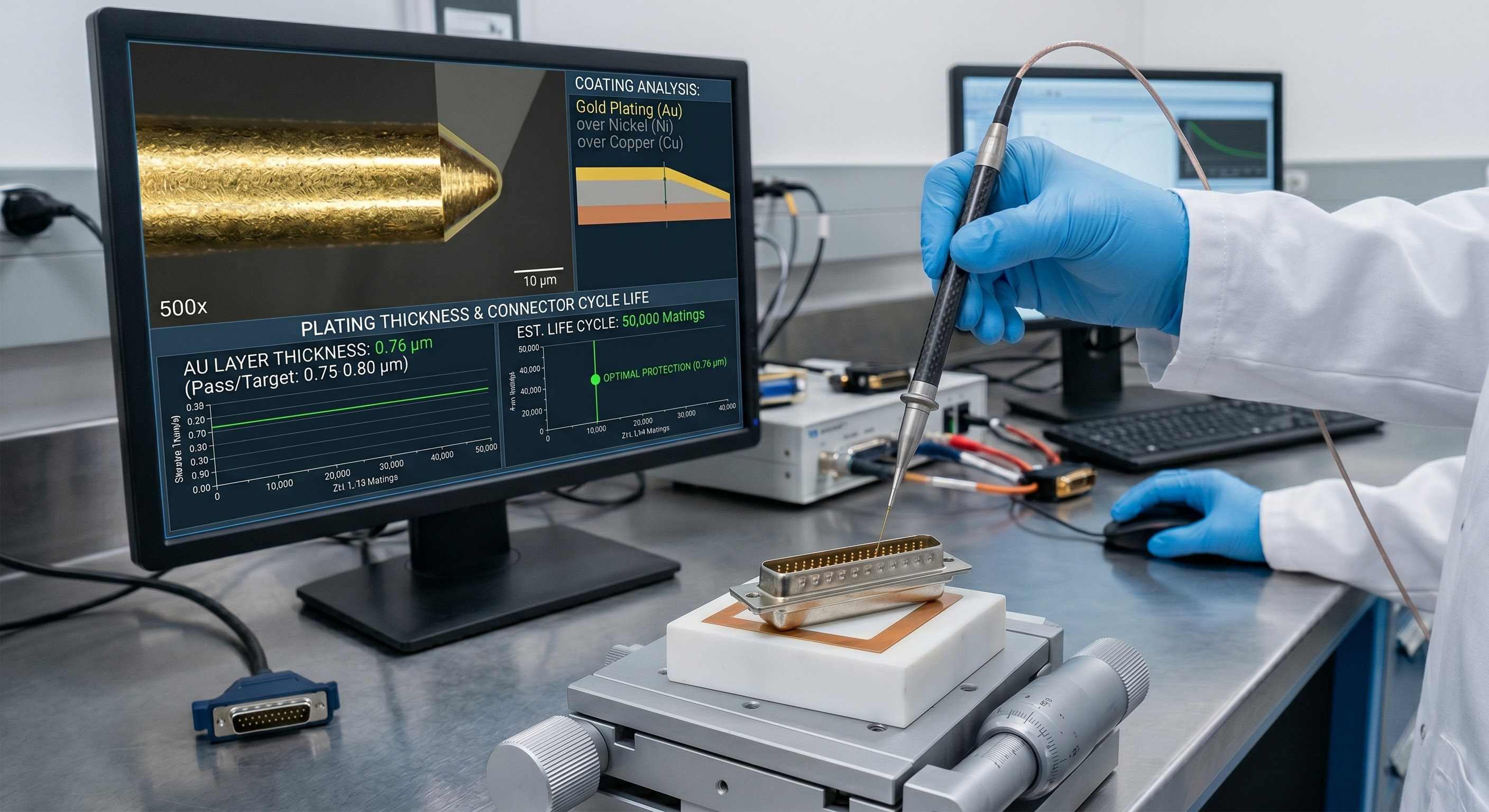
Guardians Beneath the Millimeter: How Plating Thickness Defines the Lifecycle and Reliability of Electronic Connectors
In the microscopic world of electronic connectors, the plating layer on metal terminals serves as the sole line of defense against environmental corrosion and physical wear. Although plating thickness is typically measured in micro-inches (u") or micrometers (μm), this thin metallic skin directly dictates contact resistance, antioxidant capability, and ultimate service life. In Industry 4.0 equipment where high stability is paramount, selecting the right plating specification has become a decisive factor in hardware design.
This article provides an in-depth analysis of the functional relationship between plating thickness and connector reliability, exploring how to achieve the optimal balance between cost and performance.
I. Core Functions of Plating: A Physical Barrier Beyond Conductivity
While connector terminals (such as phosphor bronze or beryllium copper) possess excellent mechanical elasticity, they are highly prone to chemical reactions in atmospheric environments, forming non-conductive oxide layers. The primary tasks of the plating layer (usually consisting of Gold, Nickel, and Tin) include:
-
Preventing Environmental Corrosion: Effectively isolating the base material from moisture, salt spray, and corrosive chemical gases in the air.
-
Reducing Mechanical Wear: Providing necessary hardness and surface lubricity to significantly reduce metal loss during frequent mating cycles.
-
Optimizing Contact Resistance: Ensuring stable, low-loss signal conduction even under low-level circuit (dry circuit) conditions.
II. Three Key Impacts of Thickness on Lifespan: Oxidation, Wear, and Structural Integrity
1. The Inverse Relationship Between Antioxidant Capacity and Porosity
Gold is an excellent inert metal, but the gold layer itself contains microscopic pores invisible to the naked eye.
■ Thin Plating (Gold Flash, < 3u"): High porosity allows the underlying nickel or copper to diffuse through the pores to the surface and oxidize, forming green rust or black spots, which leads to signal interruption.
■ Thick Plating (15u" - 50u"): As thickness increases, porosity decreases exponentially, forming a more complete physical barrier. This multiplies the stability of the connector in humid, high-temperature, or salt-spray environments.
2. Mating Cycles (Durability) and Wear Rates
Every mating cycle is a microscopic cutting process that tests the durability of the plating.
■ Wear Mechanism: Once the gold plating is worn away, exposing the base metal, contact resistance spikes instantly, leading to electrical failure.
■ Lifespan Estimation: Generally, a 30u" gold layer can withstand over 500 mating cycles, whereas 3u" Gold Flash may show performance degradation after fewer than 20 cycles.
3. Structural Support from the Nickel Underplate
The standard plating structure is: Copper Base → Nickel Underplate → Gold Surface. The nickel layer (usually required at 50u" - 100u") acts not only as a buffer to prevent atomic diffusion between gold and copper but also provides structural hardness. If the nickel layer is insufficient, the top gold film can collapse like a building constructed on sand.
III. Industry Standards for Plating Thickness
Based on different application environments and reliability needs, the industry classifies plating thickness into distinct levels:
|
Application Level |
Recommended Gold Thickness |
Typical Scenarios |
|
Commercial |
Gold Flash (~ 3u") |
Smartphone internal sockets, disposable electronics, toys |
|
Industrial |
10u" - 15u" |
Industrial PCs, automation equipment, server backplanes |
|
Mission Critical |
30u" - 50u" |
EV Battery Management Systems (BMS), satellites, medical life-support |
IV. Balancing Cost and Reliability: Precision Plating and Alternatives
Since gold is expensive, blindly increasing thickness leads to cost overruns. Modern precision manufacturing is moving toward two main directions:
■ Selective Plating: Using precision masking technology to apply heavy gold plating only to the Mating Area, while using tin plating for non-contact areas (like solder tails) to maximize cost-efficiency.
■ Palladium-Nickel (Pd-Ni) Application: Utilizing a Gold + Pd-Ni + Nickel composite structure. Research shows that Pd-Ni alloys offer higher hardness, achieving the same wear resistance and electrical performance as thick pure gold with a thinner overall profile.
Professional Q&A: Troubleshooting Plating Technology
Q1: Why do some "gold-plated" connectors turn black over time?
A: This is usually caused by Gold Flash and insufficient nickel underplate thickness. The base metal diffuses through the pores and oxidizes upon contact with air. For equipment requiring long-term stability, a minimum of 10u" is recommended.
Q2: How can I verify if a supplier's plating thickness meets the spec?
A: Professional verification methods include non-destructive testing using X-Ray Fluorescence (XRF) analyzers or destructive testing via metallographic cross-sectioning. Additionally, the Salt Spray Test is a practical benchmark for checking plating integrity.
Q3: Does thick gold plating affect SMT soldering quality?
A: Excessive gold (over 50u") can cause Gold Embrittlement when it reacts with solder, making the solder joint brittle and prone to cracking. Therefore, it is standard practice to use tin plating or selective gold plating on the Solder Tail to ensure mechanical strength.
Conclusion: Thickness is a Commitment to Quality
When evaluating connector reliability, plating thickness is a parameter hardware engineers cannot afford to compromise. For industrial or automotive equipment requiring long-term operation, choosing adequate plating thickness—while slightly increasing procurement costs—dramatically reduces the massive risks of after-sales maintenance and system downtime.
Designing a connector is essentially a race against time and the environment; plating thickness is your most reliable advantage.