
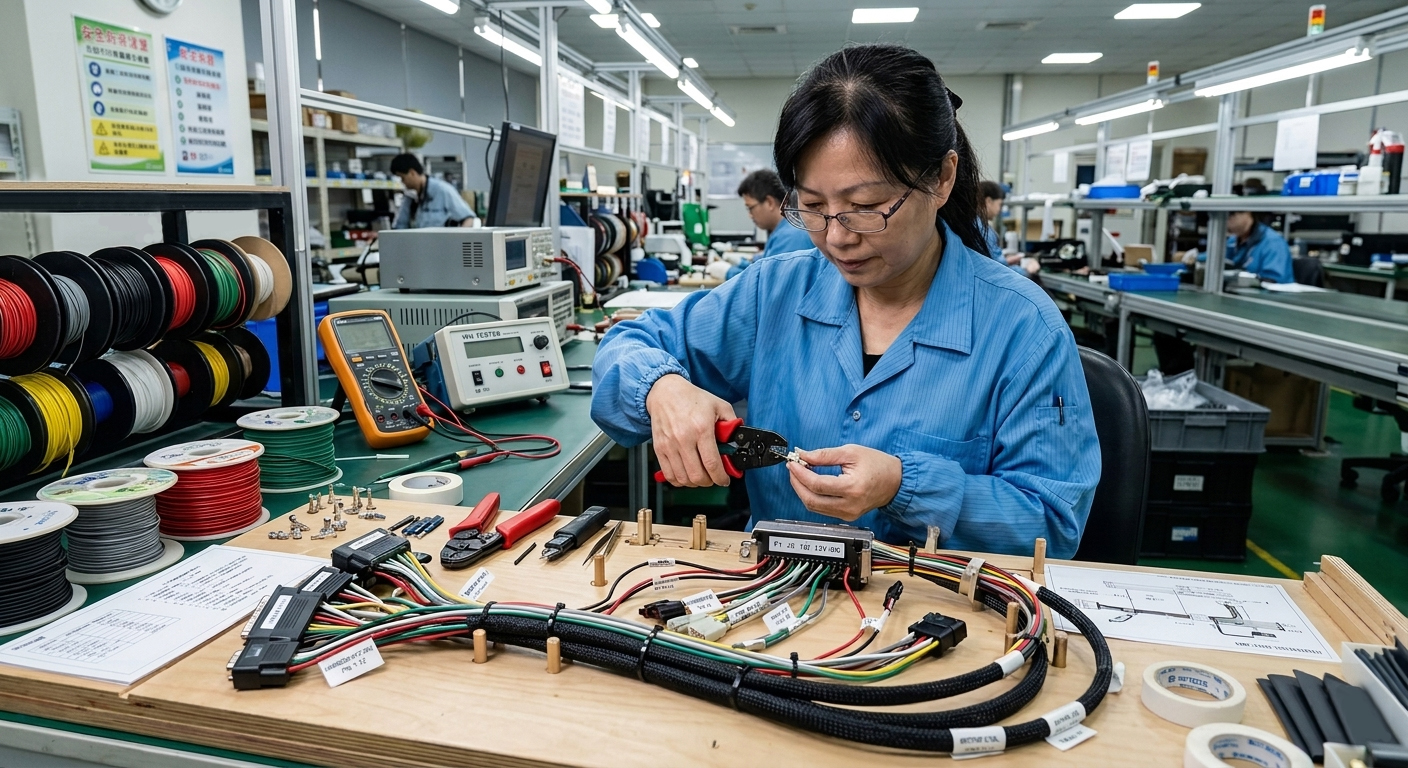
From Precision Wire Cutting to System Integration: Comprehensive Wire Harness Assembly & Custom Integration Solutions
For professional Electronics Manufacturing Services (EMS) providers, wire harness assembly and custom integration represent far more than the physical connection of conductive wires. It is a complex systems engineering process that seamlessly integrates materials science, precision craftsmanship, and rigorous quality control. In today's era of Industry 4.0 and advanced automation, a comprehensive solution must capably address the stringent demands of high-end industrial, automotive electronics, and medical device applications, all while ensuring absolute stability in signal transmission.
1. Core Technologies of Wire Harness Processing: Ensuring Electrical Stability from the Ground Up
High-quality wire harnesses must rely on baseline manufacturing processes to guarantee long-term operational reliability, particularly in application scenarios involving high-frequency signal transmission and heavy current loads.
1.Precision Auto-Cutting & Stripping: Utilizing advanced automated equipment ensures that cutting tolerances are strictly controlled within ±0.5 mm. Precise stripping depths completely eliminate the risk of strand damage, which serves as the foundation for maintaining the wire's tensile strength and electrical conductivity.
2.Crimping Technology & Failure Mode Analysis:
■ Pull Force Test: Every production batch must undergo standard tensile testing to verify that the bonding strength between the terminal and the wire strictly complies with international regulations.
■ Cross-section Analysis: Regular metallographic cross-section analysis is conducted on terminal crimps to inspect compression rates. This ensures the complete elimination of micro-voids between the wire strands and the terminal, preventing long-term oxidation and poor contact.
3.Professional Soldering & Overmolding: For military-standard circular connectors (MIL-SPEC), precision manual soldering is paired with advanced overmolding technology. This not only enhances the visual and tactile premium feel but also provides IP67/IP68-rated waterproof and dustproof protection while strengthening strain relief at the cable terminations.
2. Custom Assembly & Box Build Integration Services
Moving beyond basic wire processing, modern EMS providers have evolved to offer box build integration, effectively streamlining supply chain management for clients.
-
Diversified Connector Integration Solutions: We provide optimal component selection advice tailored to diverse physical operating environments. Whether handling D-Sub connectors, M12 circular connectors, or high-performance interconnects from Molex, JST, and TE Connectivity, we deliver precise impedance matching and low-loss signal transmission.
-
PCBA & Wire Harness Integration: We offer an end-to-end service suite spanning from Surface Mount Technology (SMT) placement to downstream manual wire harness soldering. All finished assemblies undergo strict high-potential insulation testing (Hipot Test) and electrical continuity testing to eliminate any risks of short circuits or miswiring.
-
Digital Labeling & Traceability Systems: By implementing laser engraving or dedicated heat-shrink sleeve labeling, we enable clients to perform rapid identification and streamlined maintenance within complex equipment cabinets or circuitry systems, fully aligning with the digital management requirements of Industry 4.0.
3. Material Applications for Harsh Environments: Tailored Industry Recommendations
In the face of extreme demands across different sectors, the application of materials science serves as the definitive differentiator between mediocrity and excellence:
-
High-Temperature & Chemical Resistance: Selecting Teflon (PTFE) or Silicone jacketed wires makes assemblies ideally suited for high-temperature engine bays or chemical sputtering equipment.
-
High-Flexibility & Bending Resistance: For robotic arms or automated guide tracks, we utilize high-flex robot cables engineered to withstand millions of continuous flex cycles.
-
Electromagnetic Compatibility (EMC/EMI) Shielding: Incorporating premium braid shields and ferrite cores effectively suppresses high-frequency noise interference, safeguarding data transmission quality.
4. Quality Standards & Global Industrial Certification Frameworks
In custom solutions, standardized quality forms the bedrock of long-term client trust:
|
Industry Sector |
Standard Compliance |
Core Quality Crucial Points |
|---|---|---|
|
General Industrial |
IPC-WHMA-620 |
The globally recognized acceptability standard for cable and wire harness assemblies. |
|
Automotive Electronics |
IATF 16949 |
Strict implementation of the Production Part Approval Process (PPAP) and Failure Mode and Effects Analysis (FMEA). |
|
Medical Devices |
ISO 13485 |
Stringent biocompatibility material mandates and comprehensive batch-level traceability. |
|
Environmental Compliance |
RoHS / REACH |
Ensuring components are free of hazardous heavy metals like lead and cadmium, fully conforming to ESG trends. |
5. Technical Q&A: Troubleshooting Common Wire Harness Pain Points
Q1: Why is "terminal crimping" more widely applied than "soldering" in mass wire harness production?
A: Terminal crimping offers exceptional consistency and throughput speed in automated manufacturing environments. Unlike soldering, crimping is a cold-welding process that creates no Heat-Affected Zone (HAZ). Furthermore, it provides superior mechanical stability and fatigue resistance under high-vibration environments, making it the dominant standard in automotive and industrial control sectors.
Q2: How do you mitigate the issue of voltage drop across long-distance wire harness transmissions?
A: Voltage drop is directly governed by wire gauge (AWG) and inherent impedance. We recommend appropriate wire diameters based on the client's load current requirements and utilize high-purity oxygen-free copper (OFC). Additionally, optimizing the gold-plating thickness on connector contacts effectively lowers contact resistance, minimizing energy loss.
Q3: How do you prevent wire harnesses used in outdoor equipment from becoming brittle due to environmental factors?
A: For outdoor exposure, jacket materials must feature UV-resistant properties, such as specialized formulations of PVC or TPE. In salt-spray environments, connector shells should be treated with anti-corrosion coatings, and the sealing architecture must meet IP rating standards to isolate the internal electrical interfaces from oxidation.
Precision Connectivity, Driving Infinite Possibilities in Manufacturing
A wire harness is far more than a bundle of electrical wires—it functions as the digital nervous system that bridges human ingenuity with machine kinetics. Through our rigorous five-step collaborative workflow—extending from initial requirements analysis and rapid prototyping to scale manufacturing—we transform every single conductor into an unyielding physical link. On the pathway to connecting the future, precision and reliability remain our sole commitment.