
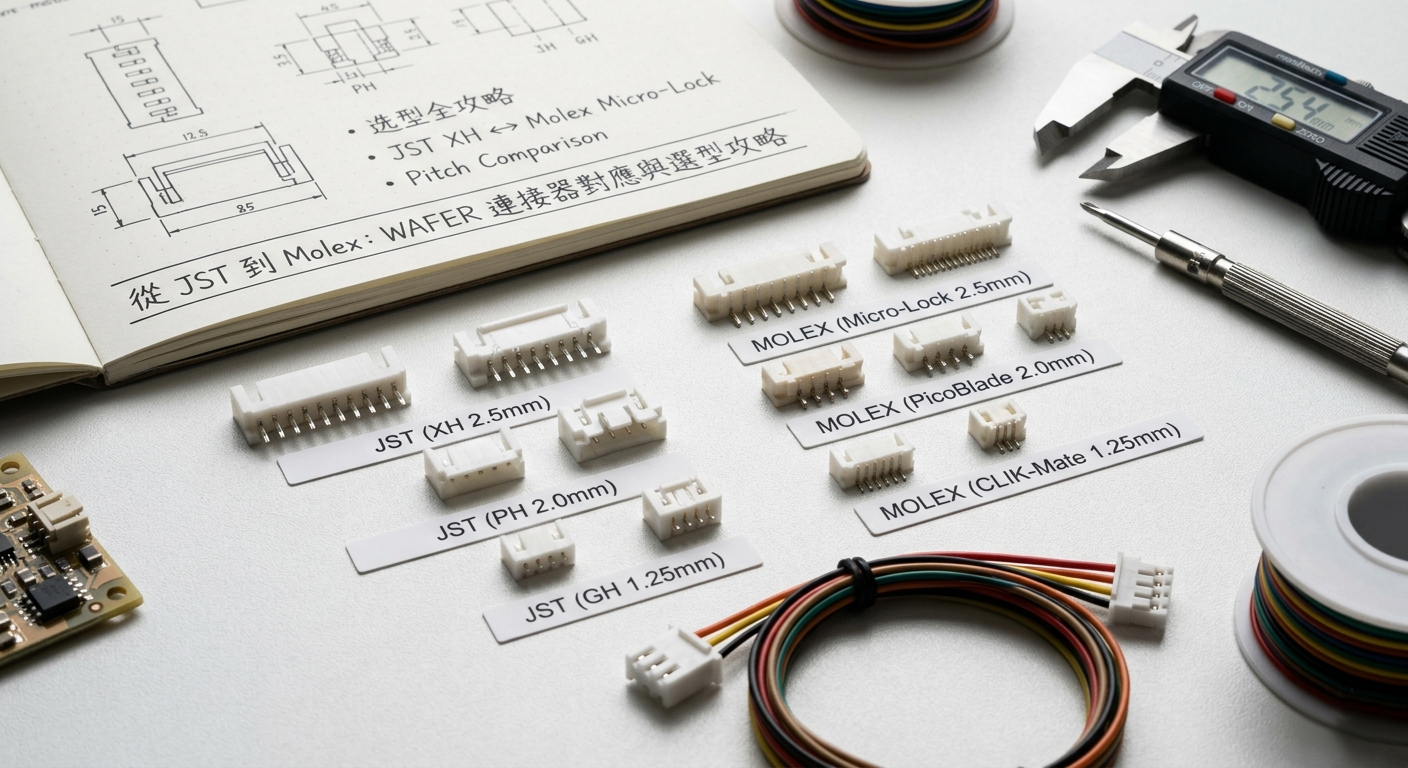
From JST to Molex: Mainstream Wafer Connector Selection Guide and Cross-Brand Model Mapping
Within the sectors of Electronics Manufacturing Services (EMS) and custom cable assembly, JST (Japan Solderless Terminals) and Molex represent the two premier titan brands commanding the highest global market share and the most standardized interface ecosystems. For hardware R&D engineers and procurement specialists, mastering the classic wafer series of these two manufacturing giants and their direct model correspondences is a foundational competency. Doing so secures PCBA component compatibility, optimizes BOM component costs, and establishes supply chain resiliency through dual-sourcing channels. Below, we break down the classic model selections and brand mapping across three primary field application profiles:
I. Subminiature Wire-to-Board Connector Selection (0.8mm - 1.25mm Pitch)
This dimensional range targets space-constrained, ultra-dense configurations such as premium smartphones, wearable electronics, high-end optical sensors, and industrial machine vision cameras.
(I) JST Subminiature Selection Matrix
- SUR Series (0.8mm Pitch): Noted as the global pioneer of 0.8mm pitch insulation displacement connectors (IDC). It stands as a baseline architecture for extreme PCB surface-area compression.
- GH Series (1.25mm Pitch): One of the most sought-after configurations in automated factory assembly lines. Its standout feature is an integrated mechanical Positive Lock Mechanism. This provides a secure tactile engagement click, which completely eliminates wire-harness back-out failures caused by operational machine harmonics and vibrations.
(II) Molex Subminiature Selection Matrix
- Pico-Lock Series (1.0mm - 2.0mm Pitch): Engineered with an exceptionally low mated profile combined with a specialized side-locking configuration. This series is explicitly tailored for ultra-thin LED panels, display backlight modules, or tight lithium-ion battery interfaces.
- PicoBlade Series (1.25mm Pitch): A classic, time-tested interconnect family with a vast legacy. While it foregoes a forced mechanical lock in favor of a slim friction-lock layout, its low vertical profile makes it ubiquitous across consumer electronics and entry-level commercial drone assemblies.
II. Mid-Pitch Mainstream Application Selection (2.0mm - 2.54mm Pitch)
This constitutes the "golden gateway" heavily utilized across major household white goods, industrial Programmable Logic Controllers (PLCs), automotive telematics, and small motor drives. It prioritizes structural durability alongside moderate current carrying capacities.
(I) JST Mid-Pitch Selection Matrix
- PH Series (2.0mm Pitch): The standard premier pick for surface-mount technology (SMT) layouts. Its highly stable structure and vast configuration variations make it the default baseline choice for hardware layout designers during early prototyping.
- XH Series (2.5mm Pitch): Widely specified for mass-market power linkages. While predominantly manufactured in traditional through-hole (DIP) form factors, it holds a dominant, immovable position within industrial power supplies and step-down transformer sub-assemblies.
(II) Molex Mid-Pitch Selection Matrix
- Micro-Latch Series (2.0mm Pitch): Architecturally parallel to JST's PH series, yet engineered with a thicker plastic insulator shell. This design places a heavier emphasis on structural strain relief and visual polarization to prevent reverse mating.
- KK 254 Series (2.54mm Pitch): Arguably the most globally recognized and historically significant connector family in existence. Its simple, reliable pin-and-header geometry handles multiple circuit matrix configurations, yielding unparalleled cross-industry versatility.
III. High-Current Power Delivery Selection (3.0mm - 4.2mm Pitch)
Tailored to satisfy heavy power delivery requirements across rack servers, data center workstations, high-power electric motors, and heavy industrial automation machinery.
(I) JST High-Current Selection Matrix
- VH Series (3.96mm Pitch): Engineered explicitly for heavy power delivery, supporting a high current rating up to 10A per pin. It is universally found on the main AC power boards of washing machines, microwaves, and rugged industrial appliances.
(II) Molex High-Current Selection Matrix
- Micro-Fit 3.0 Series (3.0mm Pitch): Molex’s flagship high-power product line, reliably driving currents up to 8.5A per contact. The SMT iterations integrate rugged metal solder tabs, making them ideal for high-throughput pick-and-place automation lines handling high-wattage PCBA modules.
- Mini-Fit Jr. Series (4.2mm Pitch): The international industrial benchmark governing desktop motherboard power delivery (such as the standard ATX 24-Pin configuration). It incorporates highly sophisticated physical polarization matrices alongside positive snap-lock retention tabs.
IV. JST to Molex Mainstream Wafer Cross-Brand Cross-Reference Matrix
In practical supply chain operations and procurement risk-hedging, secondary component manufacturers develop "Drop-in Equivalents" modeled directly after these classic primary series:
|
Application Profile |
Standard Pitch |
JST Reference Series |
Molex Reference Series |
Core Hardware Target & Key Feature |
|
Subminiature |
1.0 mm |
SH Series |
Pico-Clasp Series |
Ultra-low Z-axis clearance, ideal for miniature wearable display flex cables. |
|
Signal Routing |
1.25 mm |
GH Series |
PicoBlade Series |
JST features an active mechanical lock; Molex targets low-profile friction mating. |
|
Standard Commercial |
2.0 mm |
PH Series |
Micro-Latch Series |
Highly mature ecosystem; default choice for BMS boards and signal harnesses. |
|
Industrial / Power |
2.50mm / 2.54mm |
XH Series |
KK 254 Series |
High dielectric withstanding voltage; optimized for rugged DIP control boards. |
|
High-Current Power |
3.0 mm |
PUD Series |
Micro-Fit 3.0 |
High-density dual-row geometry packing high per-pin current capacities. |
V. Professional Technical Q&A: Cross-Brand Wafer Sourcing and Compatibility
Q1: Given the cross-brand mapping chart (e.g., JST PH mapping to Molex Micro-Latch), is it safe to plug a Molex wire-end crimp housing directly into a board-mounted JST Wafer?
A: Doing so is highly discouraged in production-grade hardware engineering. Although both components utilize an identical 2.0mm pitch and pin assignment, the two manufacturers use distinct physical tolerances regarding plastic chamfer geometries and mechanical keying slots. Intermating them often causes abnormal mating force thresholds, weak lock engagement, or unsealed mating gaps that accelerate electrochemical corrosion in humid field conditions. The gold standard for alternative component sourcing is a total interface replacement—swapping both the board-side wafer and the wire-side housing to the same compatible manufacturer family synchronously.
Q2: How can factory engineers optimize the automated SMT reflow process for large-pitch, high-current wafer connectors?
A: High-current connectors (such as the Micro-Fit 3.0 SMT variant) possess significant internal metal mass, leading to high thermal capacities. During the lead-free reflow profile phase, this can induce an unbalanced temperature delta across the pads, triggering intermittent cold joints or altering coplanarity profiles. To mitigate this via DFM optimization, the stencil aperture must be strictly calculated, and the landing pads should integrate thermal relief patterns to block large internal copper ground planes from siphoning heat away prematurely during the liquidus reflow stage.
Sourcing a Wafer connector demands that engineering and procurement teams look past a single brand's catalog in isolation. Instead, they must conduct a comprehensive assessment spanning miniaturization limitations, current threshold caps, and automated SMT processing parameters. Mastering the cross-brand mappings between JST and Molex allows product designs to achieve higher spatial flexibility in early R&D, while locking in the crucial supply chain elasticity and BOM margin optimizations required for long-term mass production.