
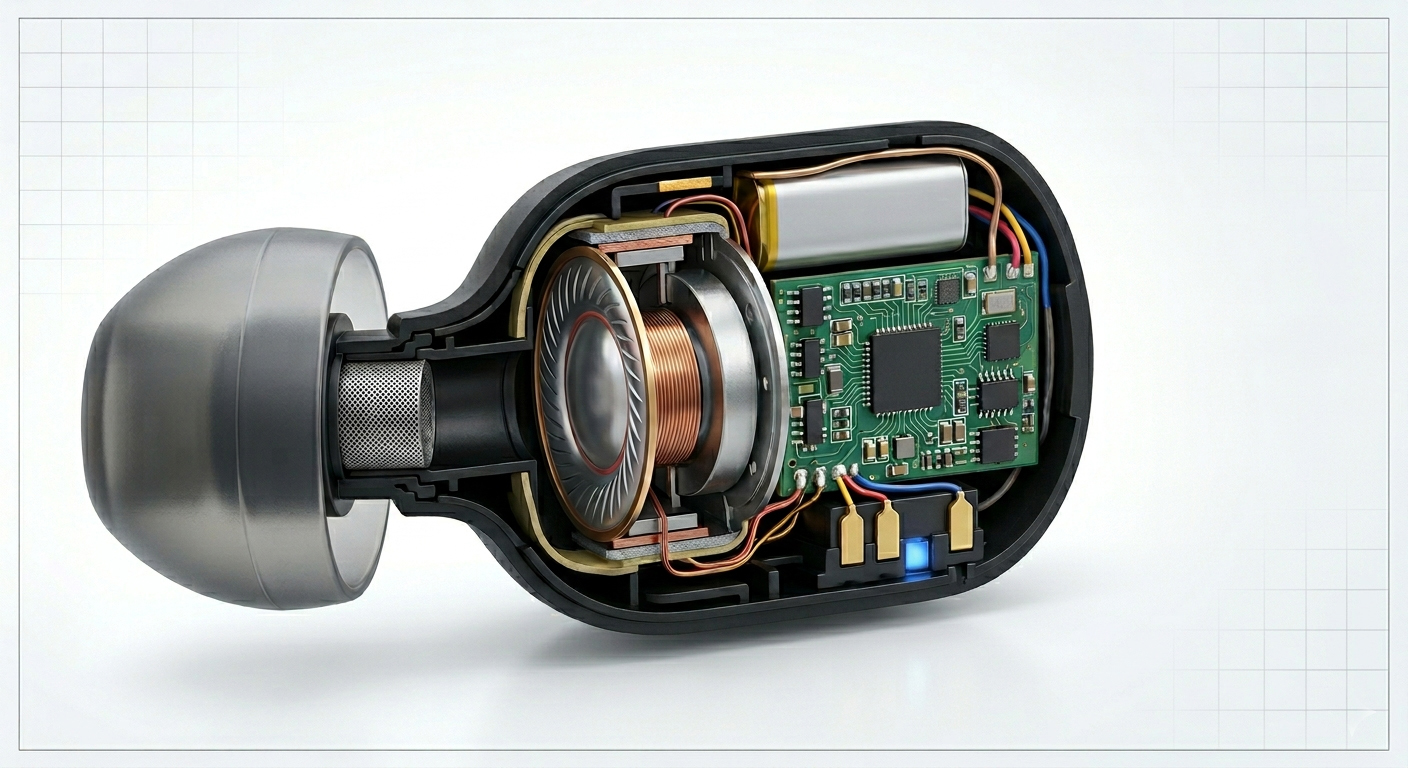
Bluetooth headsets are designed with precision and limited space, so the connectors and cables used tend to be miniaturized and highly integrated. The following are some common key internal and external components:
1. External Interfaces: Charging & Data Transmission
This is the most direct point of user contact, primarily utilized for power replenishment.
-
USB Type-C Connector: The current mainstream market standard. It supports fast charging and reversible plugging, and typically features high-efficiency EMI (Electromagnetic Interference) shielding internally.
-
Lightning Connector: Primarily used in older generations or specific series within the Apple ecosystem.
-
Magnetic Pogo Pin: Commonly found in TWS (True Wireless Stereo) earbuds. Power is transferred via metal contacts (Pogo Pins) between the earbuds and the charging case for effortless "blind-plug" charging. Its advantages include space savings and basic waterproof capabilities.
2. Internal Board-to-Board (BTB) Connectivity
Because the internal space of wireless earbuds is extremely compressed, signal bridging between Printed Circuit Boards (PCBs) is critical.
-
BTB (Board-to-Board) Connectors: Used to connect the mainboard to sub-boards (such as battery boards or touch sensor boards). They are characterized by a low profile, high retention force, and high pin density.
-
FPC/FFC (Flexible Printed Circuit) Connectors:
-
ZIF (Zero Insertion Force) Type: Used to secure flexible circuits that connect microphones, sensors, or LED indicators.
-
Non-ZIF (Slider/Drawer) Type: Offers an even smaller footprint, making it ideal for extremely narrow spaces.
-
3. Acoustic & Antenna Connectivity
-
Micro Coaxial Cable: Primarily used for Bluetooth antenna signal transmission. These cables offer excellent impedance matching and low insertion loss, ensuring a stable wireless connection.
-
Enameled Wire: Used for the voice coil inside the driver unit, responsible for converting electrical currents into acoustic signals (sound).
4. Key Material & Manufacturing Trends
To meet the demanding requirements of modern consumer electronics, these connectors and cables typically incorporate the following features:
-
High-Frequency Signal Integrity: Ensures that Bluetooth signals remain distortion-free during transmission.
-
LCP (Liquid Crystal Polymer) Material: Connector housings are frequently made of LCP due to its high heat resistance and excellent dimensional stability, making it perfectly suited for SMT (Surface Mount Technology) automated production.
-
Gold-Plating Process: Pogo Pins and contact points generally feature thickened gold plating to prevent oxidation and poor contact caused by sweat erosion.
-
Green Manufacturing (ESG): Mainstream supply chains strictly require compliance with Halogen-free and RoHS standards to minimize environmental impact.