
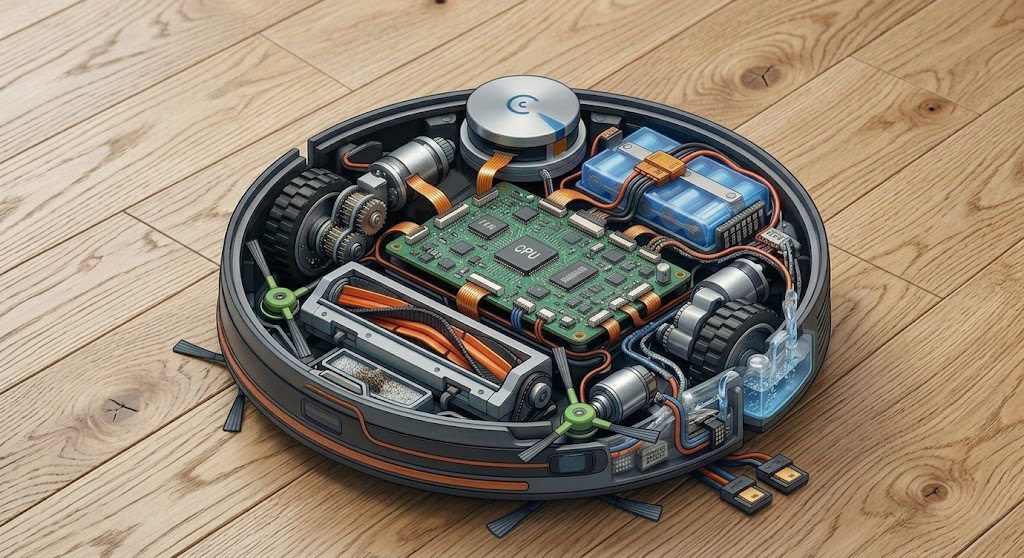
 Robot vacuums are complex electronic devices that integrate sensing technology, power drive systems, and intelligent computing. To achieve high automation within a limited chassis space, their internal architecture relies on various precision connectors and specialized wire harnesses.
Internal Connection and Wire Harness Structure of Robot Vacuums
1. Core Control & Sensing System (Signal & Data)
This section serves as the "brain" and "eyes" of the robot, demanding high signal stability and space efficiency.
■ FFC/FPC (Flexible Flat Cable / Flexible Printed Circuit):
Application: Connects LDS (Laser Distance Sensor) navigation modules, camera modules, and top cover control panels.
Features: Ultra-thin and highly bendable; ideal for routing in rotating parts (e.g., laser heads) or narrow gaps.
■ Fine-Pitch Wire-to-Board Connectors:
Specifications: Common pitches include 0.8mm, 1.0mm, or 1.25mm (e.g., JST SH / GH series).
Application: Connects drop sensors (cliff sensors), bumper microswitches, and ultrasonic sensors.
2. Power Drive System (Power & Motor)
Because robot vacuums contain multiple motors (main brush, side brushes, drive wheels), these wire harnesses must withstand high currents and frequent vibrations.
■ Medium/Low Power Motor Harnesses:
Application: Drive wheel motors, main roller brush motors, and side brush motors.
Connectors: 2.0mm or 2.5mm pitch friction-lock connectors (e.g., JST PH/XH or Molex Micro-Latch) are standard to prevent loosening caused by operational vibrations.
■ Teflon Wires / Silicone Wires:
Application: Used around motors where space is tight and heat generation is high; features excellent wear and temperature resistance.
3. Battery & Power Management System (Battery Management)
This section handles high-current transmission and safety monitoring.
■ Battery Pack Cables:
Connectors: High-current capacity connectors (e.g., Molex Mini-Fit or multi-pin proprietary battery interfaces). These typically include positive/negative power terminals alongside temperature sensing and balancing communication lines for the BMS (Battery Management System).
■ Charging Contact Plate Cables:
Application: Connects the bottom charging contacts to the internal mainboard; usually uses thicker 18AWG or 20AWG wires.
4. Water Circuit & Cleaning System (For Robot Vacuums & Mops)
Models equipped with automatic water exchange or electronic water tanks require extra wire protection.
■ Solenoid Valve Wire Harnesses: Precision signal lines used to regulate water flow.
Technical Specification Reference Table
|
Category |
Common Pitch |
Common Wire Gauge (AWG) |
Key Requirements |
|---|---|---|---|
|
Sensing & Signal |
0.5mm (FPC) / 1.0mm |
28AWG - 32AWG |
Thin, lightweight, bend-resistant |
|
Motor Drive |
2.0mm / 2.5mm |
24AWG - 26AWG |
Locking mechanism, vibration-resistant |
|
Power & Battery |
3.0mm or Proprietary |
18AWG - 22AWG |
High current capacity, low impedance |