
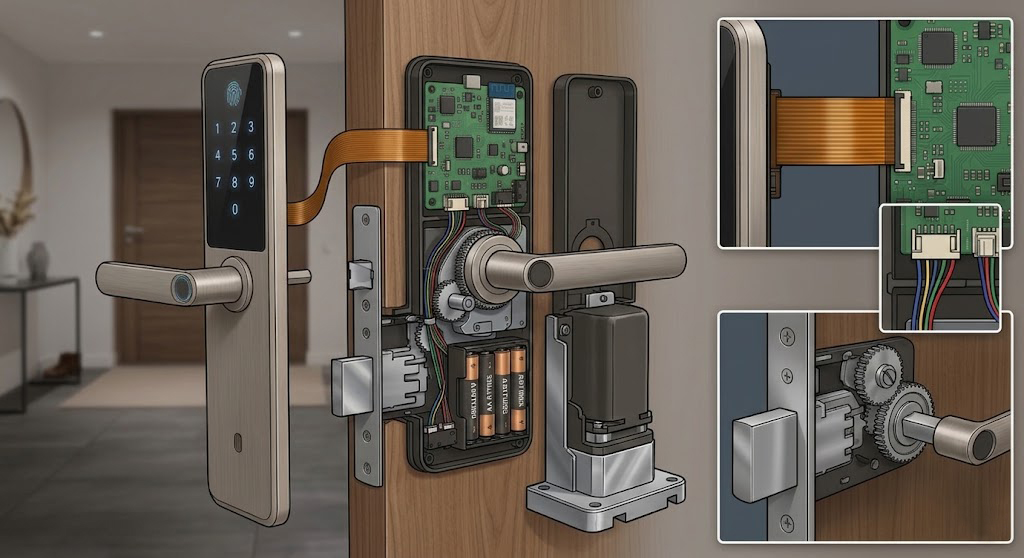
 Smart door locks have limited internal space and contain numerous functional modules. Therefore, they require various specifications of connectors and cables to connect power, sensors, and control signals.
Below are the common types of connectors and cables used in smart door locks:
1. Core Control and Panel Connection: FPC/FFC Cables and Connectors
This type of cable is most commonly used for communication between the outdoor panel (password keypad, fingerprint scanner, NFC reader) and the indoor mainboard.
■ Cable: FPC (Flexible Printed Circuit) or FFC (Flexible Flat Cable).
■ Connector: ZIF (Zero Insertion Force) or Non-ZIF connectors.
■ Advantages: Extremely thin and highly flexible. Ideal for routing through narrow spaces like door holes. Common pitches are 0.5mm or 1.0mm.
2. Power and Motor Connection: Wire-to-Board Connectors
These deliver stable current transmission to drive the motor or solenoid that turns the lock cylinder.
■ Cable: Standard hook-up wires (e.g., UL1007, UL1571 26-28AWG).
■ Connector: Miniature pluggable connectors, such as JST (SH/ZH/PH series) or Molex (PicoBlade series).
■ Advantages: Features a locking mechanism to prevent connectors from loosening due to vibrations caused by closing and opening the door.
3. Battery and Power Supply Connection: Battery Holders and Dedicated Connectors
Smart door locks typically use AA batteries, 18650 lithium-ion batteries, or proprietary lithium battery packs.
-
Dry Battery Version: Uses battery box contacts or clips to route power back to the mainboard via wires.
-
Lithium Battery Version: Uses 2-pin or 3-pin miniature connectors (including NTC temperature monitoring). Some high-end models use spring-finger (pogo pin/leaf switch) connectors similar to smartphone batteries.
-
Emergency Power Supply: A USB-C or Micro-USB port is usually placed on the exterior panel as a temporary power input when the batteries are completely dead.
4. Modular Communication and Expansion: Pin Headers and Female Headers
Used for vertical stacking connections between the mainboard and wireless communication modules (such as Bluetooth, Wi-Fi, Zigbee, or Z-Wave).
■ Specifications: Common pitches are 2.0mm or 1.27mm to optimize space saving.
■ Application: Allows manufacturers to easily swap communication modules for different markets without redesigning the mainboard.
5. Sensor Connection: Ultra-Miniature Connectors
The interior of a door lock contains numerous tiny switches, including anti-tamper switches, latch bolt position sensors, and handle-press sensors.
■ Cable: Ultra-fine hook-up wires.
■ Connector: Ultra-miniature vertical or right-angle surface-mount connectors with a 0.8mm or 1.0mm pitch.
Summary Table: Smart Door Lock Connector Applications
|
Application |
Recommended Connector / Cable Type |
Key Features |
|---|---|---|
|
Panel Communication |
FPC Cable + ZIF Connector |
Thin, high-density, highly flexible |
|
Drive Motor |
JST/Molex Wire-to-Board Connector |
Polarization (keying), secure locking, vibration resistance |
|
Communication Module |
1.27mm / 2.0mm Pin & Female Headers |
Modular design, easy replacement |
|
Emergency Power |
USB-C / Micro-USB Port |
Standardized emergency slot |
|
Sensor Switch |
Ultra-miniature Connectors (0.8mm Pitch) |
Maximizes internal structural space |