
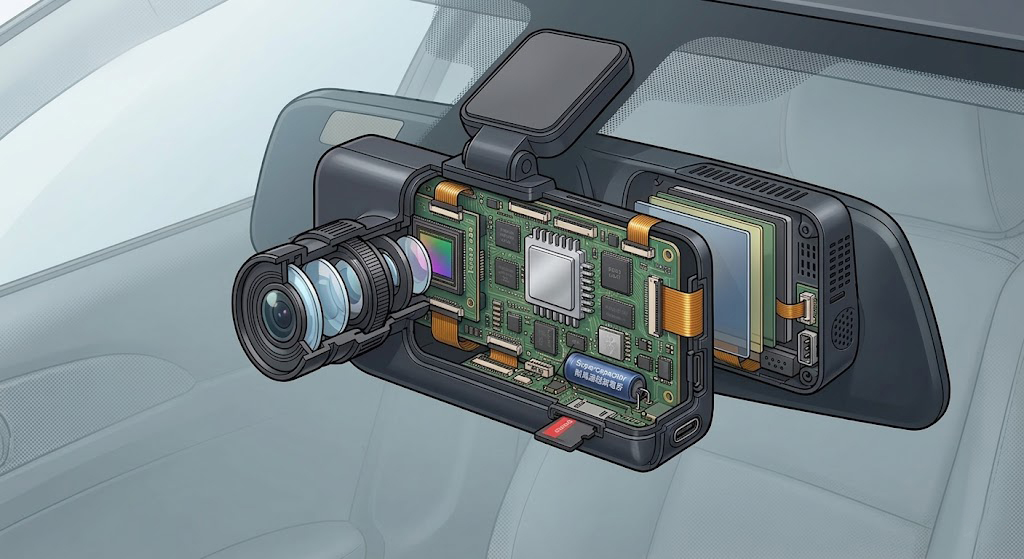
Dash cams require highly reliable connectors and cables to operate stably under extreme temperatures, constant vibrations, and high-definition data transmission demands.
The following are common types of connectors and cables used in dash cams:
1. Internal Connectors
These connectors are primarily used to connect the printed circuit board (PCB) with the CMOS camera module, display screen, or storage units.
-
FPC/FFC Connectors: Connects the CMOS camera module to the mainboard. Dash cams require compact designs, so 0.3mm or 0.5mm pitch flip-lock or slide-lock connectors are typically used to save space and ensure vibration resistance.
-
Board-to-Board (B2B) Connectors: Used for stacking connections if the dash cam utilizes a dual-layer PCB design.
-
Wire-to-Board (W2B) Connectors: Connects internal speakers, microphones, or lithium batteries. Common specifications include JST or Molex 1.0mm/1.25mm pitch series.
2. External Interfaces & Power Cables
■ USB Interfaces:
Mini USB / Micro USB: The mainstream choice for older and mid-range models.
USB Type-C: The dominant standard for current high-performance models (supporting 4K recording), providing stabler power delivery and ultra-high data transfer speeds.
■ Power Cables:
Cigarette Lighter Power Cable: Standard 12V/24V to 5V step-down step-down voltage regulator cable.
Hardwire Kit: Used for parking surveillance mode. It connects directly to the car fuse box and typically includes a low-voltage protection module to prevent car battery drain.
■ Video Transmission Cables (Rear Camera Connection):
2.5mm / 3.5mm TRRS Plugs: Commonly used for analog signal transmission.
Aviation Connectors: Features a threaded locking mechanism that is both vibration-proof and waterproof. Commonly used in commercial vehicles or high-end dual-camera models to ensure signal integrity over long distances.
3. Cable Specifications & Physical Characteristics
Due to the unique automotive environment, cables must meet the following physical requirements:
-
Shielding: High-quality cables feature braided mesh or aluminum foil shielding to prevent electromagnetic interference (EMI) from affecting GPS tracking or car radios.
-
Temperature Resistance: Must pass thermal testing (typically withstanding -20°C to +75°C or higher) to prevent cable jackets from melting or signals from degrading in high summer heat.
-
Flame Retardancy: Cables usually need to meet the UL94V-0 flame retardancy standard.
Technical Specification Reference Table
|
Item |
Common Specifications |
Key Requirements |
|---|---|---|
|
Internal FPC |
0.3 / 0.5 Pitch |
Impedance Matching |
|
External Power |
Type-C / Mini USB |
Power Stability, Surge Protection |
|
Rear Camera Cable |
Multi-core Shielded Cable |
Vibration Resistance, Tensile Strength, Anti-interference |