
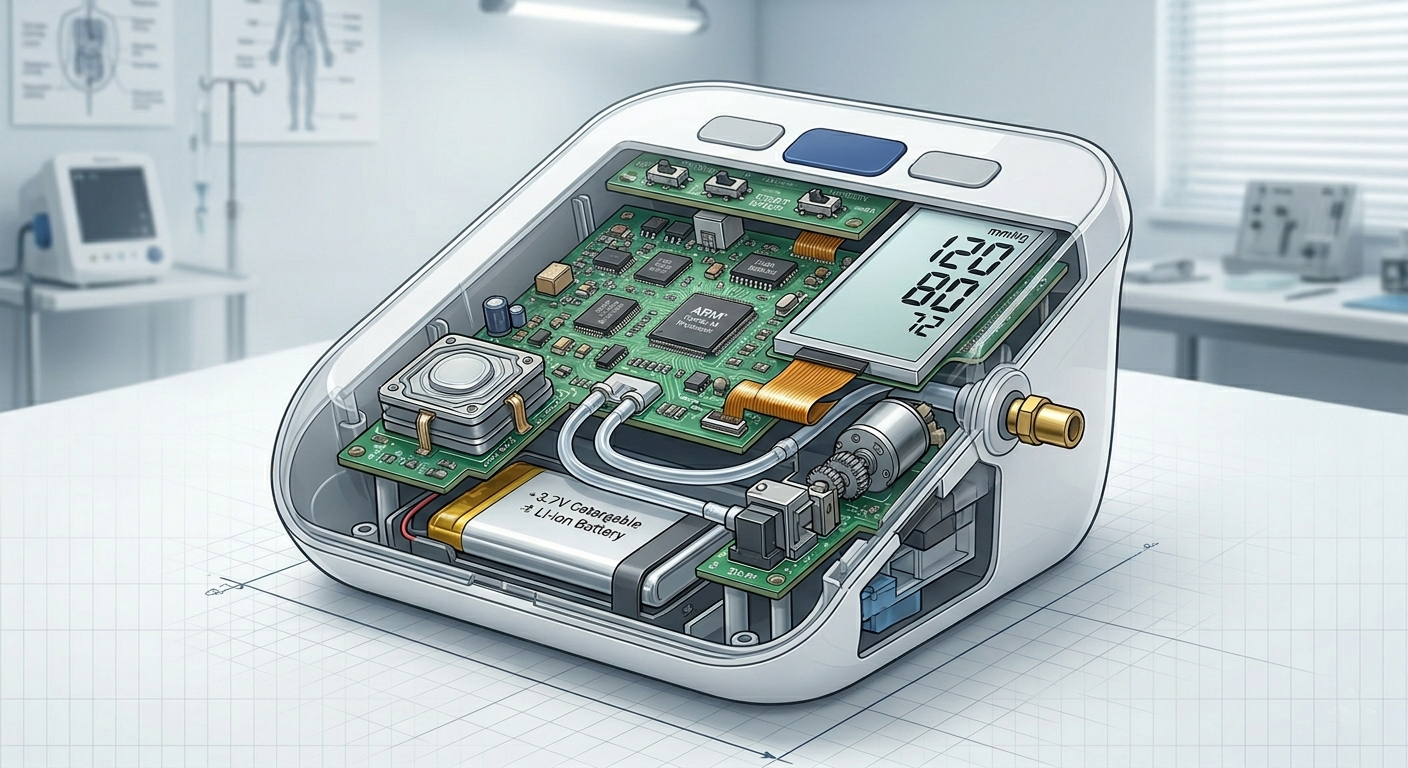
As precise medical electronic equipment, Blood Pressure Monitors require both internal and external connections that balance signal transmission stability, durability, and compliance with medical safety standards (such as ISO 13485).
The following is a classification of common connectors and wiring used in blood pressure monitors:
1. Internal Interconnects
Within the compact housing of a blood pressure monitor, connections must be made between the main board, display screen, buttons, and sensors.
■ FPC/FFC Connectors:
Application: Primarily used to connect the LCD display screen or touch panel to the main printed circuit board (PCB).
Features: Space-saving and highly low-profile. Common pitches are 0.5mm or 1.0mm.
■ Wafer / BTB (Board-to-Board) Connectors:
Application: Used to connect battery modules, pump motors, or deflation valves.
Common Specs: Polarized (key-locked) connectors with 1.25mm or 2.0mm pitches to prevent reverse polarity during assembly.
2. Power & Data Transmission
Modern blood pressure monitors often feature data uploading (App syncing) or direct plug-in capabilities.
■ USB Type-C or Micro-USB:
Application: Charging or transmitting measurement data to computers/smartphones.
Trend: Driven by EU regulations and universal compatibility needs, Type-C has become the mainstream standard for new medical devices.
■ DC Jack:
Application: Traditional models frequently use cylindrical DC jacks connected to power adapters for direct power supply.
3. Pneumatic Connectors (Critical Gas Path)
This is the most specialized part of a blood pressure monitor, used to connect the main unit to the cuff.
■ Quick-Disconnect Air Connectors/Nipples:
Application: Connects the inflation tubing.
Features: Must offer exceptional airtightness and be easy to plug and unplug with one hand. Usually made of plastic (ABS or POM) materials.
■ PVC/Silicone Inflation Tubing:
Features: Requires kink resistance and biocompatibility to ensure uniform pressure transmission during the inflation process.
4. Sensor Wiring
■ Ultra-fine Coaxial or Shielded Wires:
Application: Used to capture weak pressure pulse signals.
Features: Because blood pressure signals are extremely faint, the wiring must feature excellent EMI/EMC shielding capabilities to prevent ambient noise from interfering with measurement results.
Summary Table
|
Component Name |
Recommended Type |
Application Location |
|---|---|---|
|
Display Interface |
FPC/FFC Connector |
Between screen and PCB |
|
Power Connection |
Wafer / Wire-to-Board |
Power lines for inflation pumps and solenoid valves |
|
Data Interface |
USB-C / Micro-USB |
Charging and Bluetooth/Data exchange |
|
Pressure Transmission |
Quick-disconnect air connector |
Connection point between host unit and cuff |
|
Internal Signal |
Shielded Wire |
Pressure Sensor |
When designing these types of products, in addition to mechanical specifications, compliance with environmental regulations such as RoHS and REACH is typically required, alongside ensuring that connectors can withstand frequent mating cycles (insertion and withdrawal wear).