
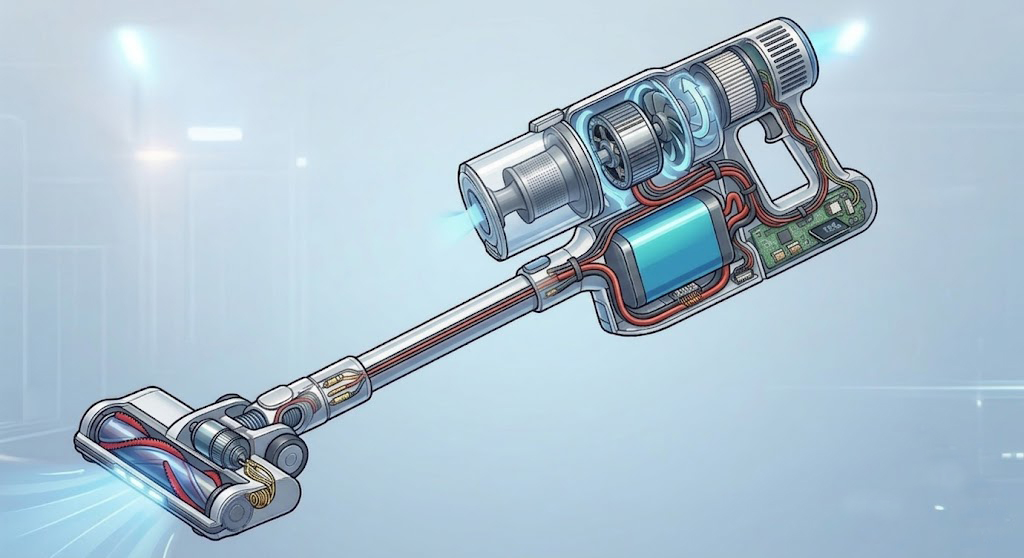
 Modern cordless handheld vacuum cleaners feature highly sophisticated internal electronics. To reliably transmit current and signals among high-speed motors, sensors, and Battery Management Systems (BMS), they rely on a variety of high-performance connectors and wiring solutions.
The following are the common connection and wiring solutions used in vacuum cleaners:
1. Power & Battery Management
This section handles the highest current in the vacuum cleaner and must possess low contact resistance and high-temperature resistance.
-
High-Current Battery Interfaces: Used to connect detachable battery packs to the main body. These typically utilize blade-type or spring-contact connectors to ensure stable power delivery under constant vibration.
-
BTB (Board-to-Board) Connectors: Used to interface the battery protection board with the main control board.
-
Silicone Wires: Since motor operation generates significant heat, power lines often use silicone wires rated up to 200°C. They offer excellent flexibility for routing in tight spaces.
2. Motor & Suction Control
-
Wire-to-Board Connectors: Used to drive high-speed Brushless DC (BLDC) motors. Common specifications include the JST PH/XH series or higher-power options like the Molex Micro-Fit series.
-
Nylon Cable Ties & Heat Shrink Tubing: To prevent wire wear or disconnection caused by high-speed operational vibrations, internal wire harnesses are thoroughly bundled and reinforced.
3. Signal & Display (Sensors & Panels)
Modern vacuum cleaners are equipped with LED/OLED screens, dust sensors (such as infrared sensors), and pressure sensors.
-
FPC/FFC Connectors: Utilized in areas with extremely limited internal space, such as connecting the handle's display screen or keypads. They usually employ 0.3mm or 0.5mm pitch flip-lock connectors to reduce overall machine weight.
-
Shielded Cables: Used for transmitting sensor signals to prevent electromagnetic interference (EMI) generated by the motor from affecting sensor accuracy.
4. Extension & Tooling Interfaces
-
Metal Contacts (Spring Pins / Pogo Pins): At the joints connecting the extension wand and motorized brush heads, gold-plated pogo pins or spring-blade connectors are used to transmit power to the roller brush motor.
-
Concealed Coiled Wires: Inside certain extendable or flexible wands, telephone-style coiled wires are implemented to withstand frequent bending and stretching without breaking.
Summary Table of Common Specifications
|
Component |
Recommended Connector / Wire Type |
Key Features |
|---|---|---|
|
Battery Management |
High-Current Blade, High-Current Connector |
Vibration resistance, low temperature rise |
|
Motor Control |
Wire-to-Board (e.g., Micro-Fit) |
Locking mechanism, polarization (foolproofing) |
|
Panel / Signal |
FPC/FFC Connectors |
Ultra-thin, high-density layout |
|
External Brush Heads |
Pogo Pin / Conductive Wand Connectors |
Easy plug-and-play, wear resistance |
|
Internal Wiring |
UL1007, Silicone Wire, Teflon Wire |
Voltage resistance, high-temperature resistance |