
The Ultimate Guide to Waterproof Connectors: From Structural Classifications to Industrial Selection Best Practices
In industrial automation, outdoor telecommunications, and automotive electrical systems, the varieties of waterproof connectors are exceptionally diverse. To accommodate varying transmission mediums (power, high-frequency data, control signals), external mechanical profiles, and extreme climate demands, engineering and procurement teams systematically classify and select interconnect architectures across four primary dimensions:
I. Classification by "External Profile and Mechanical Locking Mechanism"
The geometric housing design and mechanical locking mechanism of a connector directly dictate the compression uniformity of its elastomeric O-ring, determining its long-term sealing efficiency.
(I) Circular and Rectangular Heavy-Duty Architectures
- Circular Waterproof Connectors
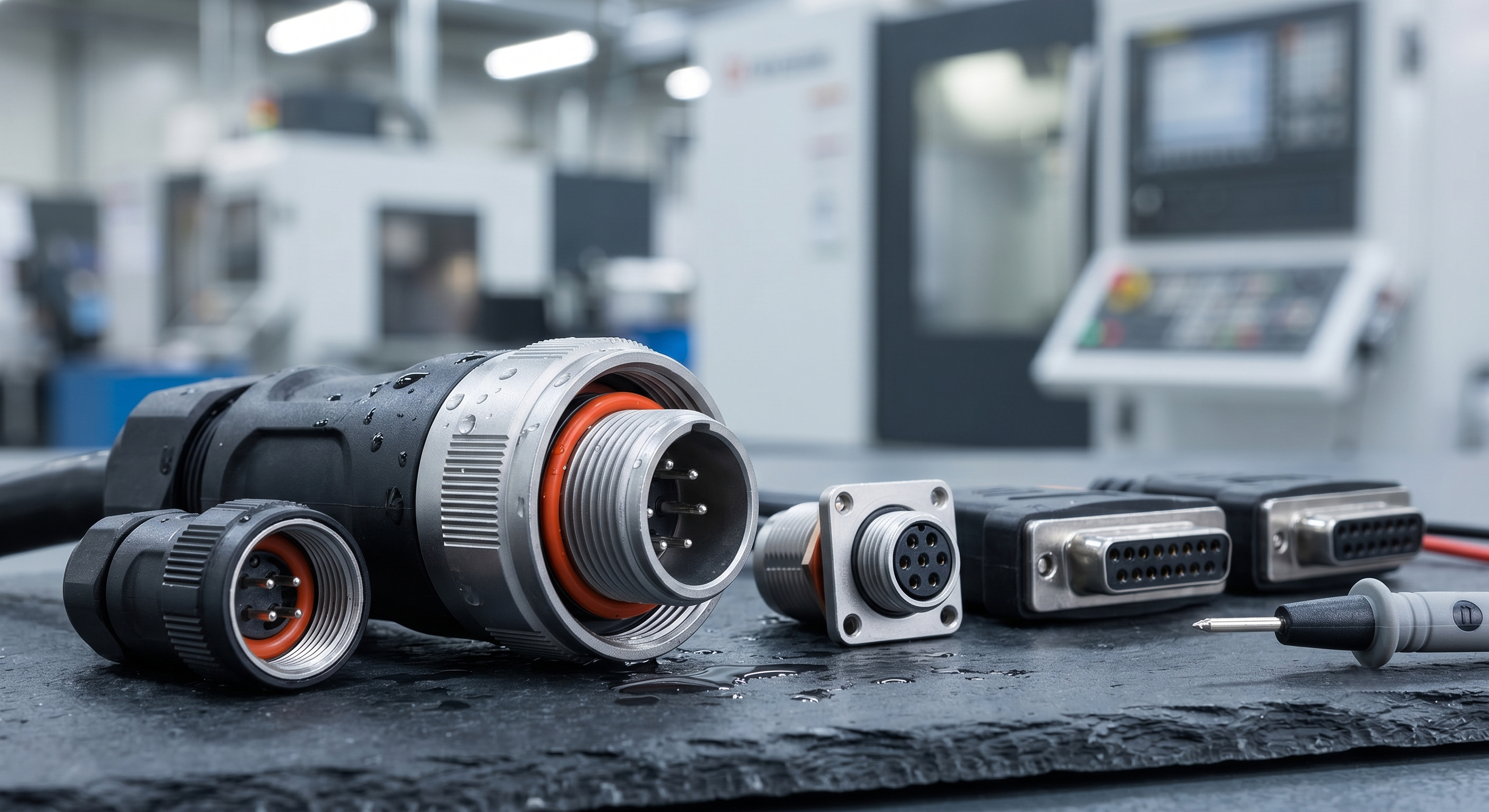
(1) This represents the most ubiquitous standard waterproof configuration in the industrial sector. Leveraging the natural physics of a circular body to distribute mechanical stress uniformly, it utilizes threaded couplings or three-point bayonet locks to comfortably achieve IP67, IP68, or even IP69K protection ratings.
- Rectangular / Heavy Duty Connectors (HDC)
(1) These are typically deployed in complex automation systems requiring high-density pin configurations or a combination of heavy power rails and sensitive logic signals.
(2) The enclosures are mostly cast from aluminum alloys or high-grade reinforced polymers, paired with rugged single- or double-locking lever systems that offer exceptional vibration dampening and fluid isolation.
(II) Quick-Disconnect Locking Systems
- Push-Pull Waterproof Connectors
(1) This style prioritizes a high-speed, intuitive mating experience. Pushing the plug into the receptacle automatically triggers a mechanical locking sequence, while unmating requires a simple axial pull on the specialized outer slider sleeve.
(2) These are ideal for space-constrained environments requiring frequent maintenance diagnostics or rapid sub-system hot-swapping, such as surgical instruments and patient monitoring consoles.
II. Classification by "Standardized Industrial Configurations (Metric M-Series)"
In automated production lines, industrial sensors, and industrial Ethernet topologies, standardized circular connectors are named and categorized primarily by their metric thread diameter (M):
(I) M5 / M8 and M12 Automation Mainstays
- M5 / M8 Subminiature Connectors: Compact in footprint, these are used primarily in miniature proximity sensors, pneumatic control valves, or space-restricted Industrial Internet of Things (IIoT) edge-node telemetry devices.
- M12 Connectors (The True Backbone of Industrial Automation): Their internal pin arrangements feature specialized coding geometries to target distinct signal types natively:
(1) A-Coding: Universally used for traditional sensor-actuator loops and low-voltage DC power distribution.
(2) B-Coding: Engineered explicitly for Profibus fieldbus industrial networks.
(3) D-Coding: Reliably handles Fast Industrial Ethernet transmission up to 100 Mbps.
(4) X-Coding: Outfitted with internal cross-shaped electromagnetic shielding, optimized specifically for 10 Gbps Gigabit Ethernet and high-frequency, high-bandwidth data arrays.
(II) M23 / M40 Heavy Power Specifications
- Heavy-Duty Electromechanical Power Delivery: These variants are sourced for three-phase high-power delivery to servo motors and high-frequency encoder feedback transmissions. Their massive shell architectures provide exceptional physical shock dampening and 360º EMI shielding effectiveness.
III. Classification by "Transmission Interface and Practical Field Application"
A prominent trend in Industry 4.0 hardware is the "industrialization" of commercial-grade communication interfaces, yielding specialized rugged variants:
(I) High-Speed Data and Fiber Optic Protection
- Waterproof RJ45 Connectors: Enclosing a standard RJ45 modular plug within a rigid, gasket-sealed outer housing with threaded locking rings, these are heavily deployed on outdoor 5G cellular base stations, rugged IP security cameras, and dust-heavy industrial network switches.
- Waterproof USB / Type-C Interfaces: As smart mobile diagnostic tools proliferate, IP67-rated Type-C ports have become standard configurations on rugged field tablets and outdoor motorcycle charging terminals.
- Waterproof Fiber Optic Connectors: Specialized for long-distance, ultra-high-bandwidth optical transmissions, such as Fiber-to-the-Antenna (FTTA) links on cellular masts.
(II) Heavy Current Power and Renewable Energy
- Energy Storage Systems (ESS) and EV Charging Interconnects: Engineered to throttle extreme voltages and high currents safely, these systems include strict High-Voltage Interlock Loop (HVIL) safety circuits and active touch-proof insulation boundaries.
- Photovoltaic (PV / Solar) Connectors: Standardized interfaces like the MC4 connector must survive continuous outdoor exposure, resisting intense ultraviolet (UV) radiation, severe thermal cycling, and torrential rains for decades without experiencing polymer embrittlement.
IV. Technical Cross-Reference Matrix of Cable Assembly Processing Methods
During PCBA cable manufacturing and enclosure chassis assembly, the method used to bond the connector to the raw wire and printed circuit board introduces separate engineering parameters:
|
Processing Methodology |
Technical Features & Manufacturing Flow |
Core Fluid Sealing Mechanism |
Ideal Target Applications |
|
Overmolded Cable Assemblies |
The connector and raw cable jacket are fused directly via an injection molding tool utilizing PVC, PUR, or TPR resins. |
Physical Monolithic Seal: High-pressure molten plastic completely encapsulates wire-core interstices, delivering premium fluid sealing and robust strain relief. |
Factory-standardized mass cable assemblies, automotive camera modules, exterior sensor tails. |
|
Field Installable Connectors |
Allows field technicians to terminate bare wire conductors on-site via internal screw clamps or localized solder cups. |
Elastomeric Glands & Compression Nuts: Relies completely on manual torque values. Offers exceptional field layout flexibility but is highly dependent on proper technician technique. |
On-site telecom mast repairs, custom large-scale electrical control enclosure installations. |
|
Panel Mount Connectors |
Receptacles rigidly fastened to the equipment chassis shell, with their rear pins terminated directly to the internal PCB via DIP or SMT processing. |
Front/Rear Sealing Gaskets: Compressed via locknuts to ensure that the physical tolerance gap between the connector shell and the chassis cutout remains hermetic. |
Industrial PC chassis IO interfaces, PLC module output ports, instrument enclosures. |
V. Professional Technical Q&A: Waterproof Connector Field Selection Insights
Q1: How should engineers choose between PUR and PVC raw cable jacket materials for waterproof assemblies?
A: The decision depends on mechanical articulation and chemical exposure. PVC (Polyvinyl Chloride) is highly cost-effective and perfectly suited for static, fixed outdoor installations. Conversely, PUR (Polyurethane) exhibits exceptional resistance to mechanical tearing, industrial lubricants, oil hydrolysis, and low-temperature flexibility. If your waterproof connector assembly routes through continuous bending trajectories—such as "drag chains" on multi-axis robotic arms or CNC milling centers exposed to cutting fluids—specifying a PUR cable jacket is mandatory.
Q2: Does integrating Electromagnetic Compatibility (EMC) shielding compromise a connector's waterproofing attributes?
A: No, the two functions operate independently and coexist harmoniously within high-end interconnect designs. Premium shielded waterproof connectors (such as an M12 X-coded assembly) incorporate a 360º internal metal shielding ring that establishes continuous electrical contact with the braided shield of the cable to channel EMI noise to ground. Externally, fluid isolation remains governed by independent rubber O-rings and compression nuts. Datasheets will always list "Shielded" and "IP Rating" as separate mechanical compliance items.
VI. Conclusion and Supply Chain Optimization Benchmarks
When evaluating a waterproof connector architecture, hardware architects and procurement managers cannot blindly target the highest "IP Rating" in isolation. Instead, they must conduct a comprehensive assessment encompassing electrical properties (current ratings, dielectric withstanding voltage, impedance matching), mechanical properties (mating cycles, shock and vibration thresholds), and environmental tolerances (operational temperature windows, UV resilience, chemical and salt-fog corrosion resistances). In an era prioritizing Design for Manufacturability (DFM) and optimized BOM costs, selecting precisely engineered, rigorously validated equivalent options from tier-1 manufacturers remains a highly effective and common strategy to hedge supply chain risks.