
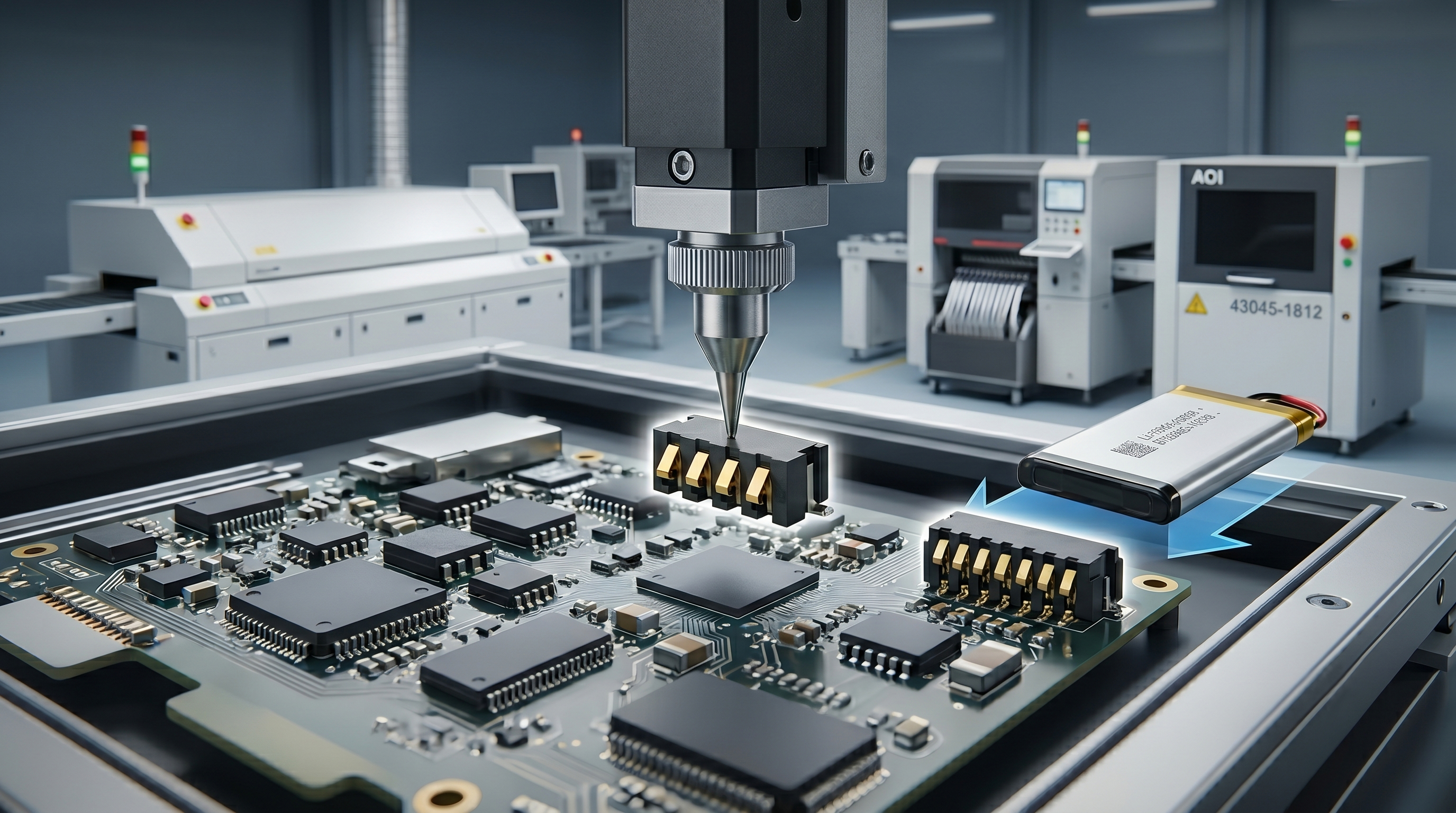
The Bedrock of High-Efficiency Manufacturing: Surface Mount Technology (SMT) Battery Connector Technology and Industrial Selection Guide
In the electronics manufacturing services (EMS) sector, manufacturing throughput and end-product reliability serve as the twin pillars of corporate competitiveness. As printed circuit board assembly (PCBA) methodologies transition entirely from legacy through-hole technology (DIP) to surface mount technology (SMT), surface mount battery connectors have emerged as the dominant power interface protocol across smartphones, wearable tech, smart telematics, and industrial internet of things (IIoT) sensor nodes. Below, we dissect the core advantages and processing parameters of SMT battery connectors from both a product marketing and hardware engineering perspective.
I. What is an SMT Battery Connector? Structural Substrate and Retention Mechanics
A Surface Mount Technology (SMT) battery connector is a precision-engineered electronic component designed to be soldered directly onto the surface landing pads of a PCB.
-
Fundamental Divergence from Through-Hole (DIP) Processing
(1) Unlike legacy components that penetrate the substrate via plated through-holes (PTH), SMT battery connectors rely entirely on the surface tension of wet solder paste and the melting kinetics of infrared reflow soldering for physical anchoring.
-
Material Science Composition
(1) The structural profile generally comprises an insulating polymer housing optimized for extreme rigidity and thermal tolerance.
(2) Embedded within the housing are metal spring contacts or precision pin interfaces boasting excellent elasticity, low contact resistance, and premium solderability.
II. The Four Core Hardware Advantages of Surface Mount Interconnect Architectures
Migrating battery connector footprints entirely to SMT profiles injects revolutionary efficiencies into a product's Design for Manufacturability (DFM) workflow:
(I) High-Precision Pick-and-Place Automation and Footprint Optimization
- Enabling High-Speed Automated Assembly Lines
SMT connectors are packaged and shipped in standard Tape & Reel formats. Interfacing seamlessly with the high-speed vacuum nozzles of automated pick-and-place machinery, they enable precision placement of tens of thousands of units per hour, eliminating manual assembly overhead and securing absolute parts-per-million (PPM) yield consistency.
- Reclaiming Secondary Layer Routing Real Estate
Because SMT components eliminate the need for drilled holes through the substrate, the bottom side of the PCB is entirely reclaimed. Layout engineers can utilize this space to route secondary circuit traces or drop passive components, which is vital for space-constrained, miniaturized wearable enclosures.
(II) Electrical Performance Integrity and Chassis Weight Reduction
- Premium Power Delivery Profiles
(1) SMT contact leads feature highly truncated physical profiles, effectively minimizing parasitic inductance and contact resistance.
(2) For Battery Management Systems (BMS) requiring ultra-precise, real-time voltage compensation telemetry, this architecture yields a cleaner power delivery path with minimized harmonic noise.
- Aligning with Modern Mobile Hardware Trends
(1) Eliminating elongated through-hole pins curbs the component’s absolute metal usage and bulk mass, fitting the rigorous "lighter, thinner, shorter, smaller" form-factor constraints of modern mobile devices.
III. Critical SMT Manufacturing Metrics and Hardware Engineering Safeguards
To extract the maximum performance from an SMT battery interface, hardware designers and production engineers must strictly control three primary structural parameters:
(I) Thermal Stress Resilience and Mechanical Joint Reinforcements
- Withstanding Lead-Free Reflow Profiles
(1) The plastic connector housing must be molded from high-temperature engineering resins like Liquid Crystal Polymer (LCP) or PA9T.
(2) This guarantees the component preserves its mechanical tolerances and undergoes zero physical warping, blistering, or pin-shifting when exposed to lead-free reflow peak oven zones reaching 260°C.
- Solder Joint Anti-Peeling Defenses (Solder Tabs / Anchors)
(1) To prevent users from cracking solder joints during repeated battery extraction or insertion cycles, advanced SMT connectors incorporate non-conductive mechanical anchors or solder tabs on their outer flanks to exponentially boost the component’s peel strength against the PCB.
(II) Strict Coplanarity Control
- Preventing Solder Voiding and Non-Wetting Crises
(1) The coplanarity profile across all contact leads along the bottom face of an SMT connector must reside on a strictly uniform horizontal plane, typically mandating a maximum variance deviation under 0.1mm.
(2) Exceeding this tolerance threshold causes shorter leads to experience non-wetting or intermittent cold joints during the reflow phase, embedding a ticking time bomb of contact failure into the post-sale consumer market.
IV. Core Field Applications and Substrate Environmental Adaptation
Leveraging its exceptional mass-production compatibility and environmental resilience, the SMT battery connector has secured baseline status across three main high-value market verticals:
(I) Consumer Electronics, IoT, and Medical Instrumentation
- Consumer Electronics: True Wireless Stereo (TWS) earbud charging cases, flagship smartphones, and portable handheld gaming consoles.
- Internet of Things (IoT / IIoT): Wireless edge-sensor nodes and smart access control locking systems (frequently utilizing integrated SMT coin-cell retainers).
- Medical & Industrial Devices: Portable patient vital-sign monitors, automated external defibrillators (AEDs), and ruggedized logistics barcode scanners.
When deployed in volatile industrial zones subject to operational harmonics or sharp thermal fluctuations, the SMT layout must be paired with specialized solder paste chemistry (such as anti-silver-migration formulas) and strict stencil aperture thickness parameters to maximize the fatigue life of the metal joints.
V. Technical Comparison Matrix of Three Main SMT Battery Contact Structures
|
Contact Profile Category |
Lead Deflection & Structural Features |
Mechanical Retention & Engagement Style |
Ideal Target Application Profiles |
|
Leaf Spring Style |
Long Z-axis compression stroke; yields high tolerance for vertical variances. |
Relies on the natural spring-back tension of the metal leaf to hold contact. |
Removable smartphone battery slots, industrial two-way radios. |
|
Pogo Pin Style |
Houses internal micro-helical springs; achieves point-to-point vertical mating. |
Microscopic contact footprint; demands tight external housing assembly tolerances. |
Magnetic smartwatch charging docks, wireless earbud stem contact nodes. |
|
Blade / Plug Style |
Sliding planar blade engagement; features extended wiping lengths. |
Provides distinct tactile feedback; exceptional resistance to shear and vibration. |
Dashcams, heavy high-capacity lithium packs for mobile field instrumentation. |
VI. Professional Technical Q&A: SMT Battery Connector Field Insights
Q1: If a high-volume assembly line encounters recurring "Tombstoning" defects on SMT battery connectors, how should we optimize the design?
A: Tombstoning occurs when the solder paste on opposing landing pads melts at asymmetrical intervals, generating unbalanced surface tension forces that lift the component. To rectify this via DFM optimization, verify that the trace widths and thermal relief patterns feeding into the landing pads are perfectly symmetrical. Furthermore, modifying the reflow oven's pre-heat profiling allows the component body to achieve complete thermal equilibrium prior to entering the liquidus zone, dampening the defect rate.
Q2: How can QC lines audit hidden cold joints underneath the insulator body of miniature SMT battery connectors?
A: Because miniature connector configurations often place contact leads directly beneath the component chassis, traditional automated optical inspection (AOI) lenses hit severe visual blind spots. In premium tier-1 EMS facilities, engineers deploy Automated X-ray Inspection (AXI) to pierce the polymer housing, evaluating wetting angles and voiding rates directly to guarantee electrical safety during high-current battery discharge states.
VII. Conclusion
The surface mount technology (SMT) battery connector represents far more than a passive bridge conducting power; it acts as a critical gateway enabling modern electronic assemblies to scale smoothly into sub-millimeter precision and high-throughput automated mass production. By optimizing PCB pad geometry and specifying ultra-precise, temperature-resilient base materials, hardware manufacturers can lock in long-term product field durability while extracting maximum assembly line yield efficiencies.