
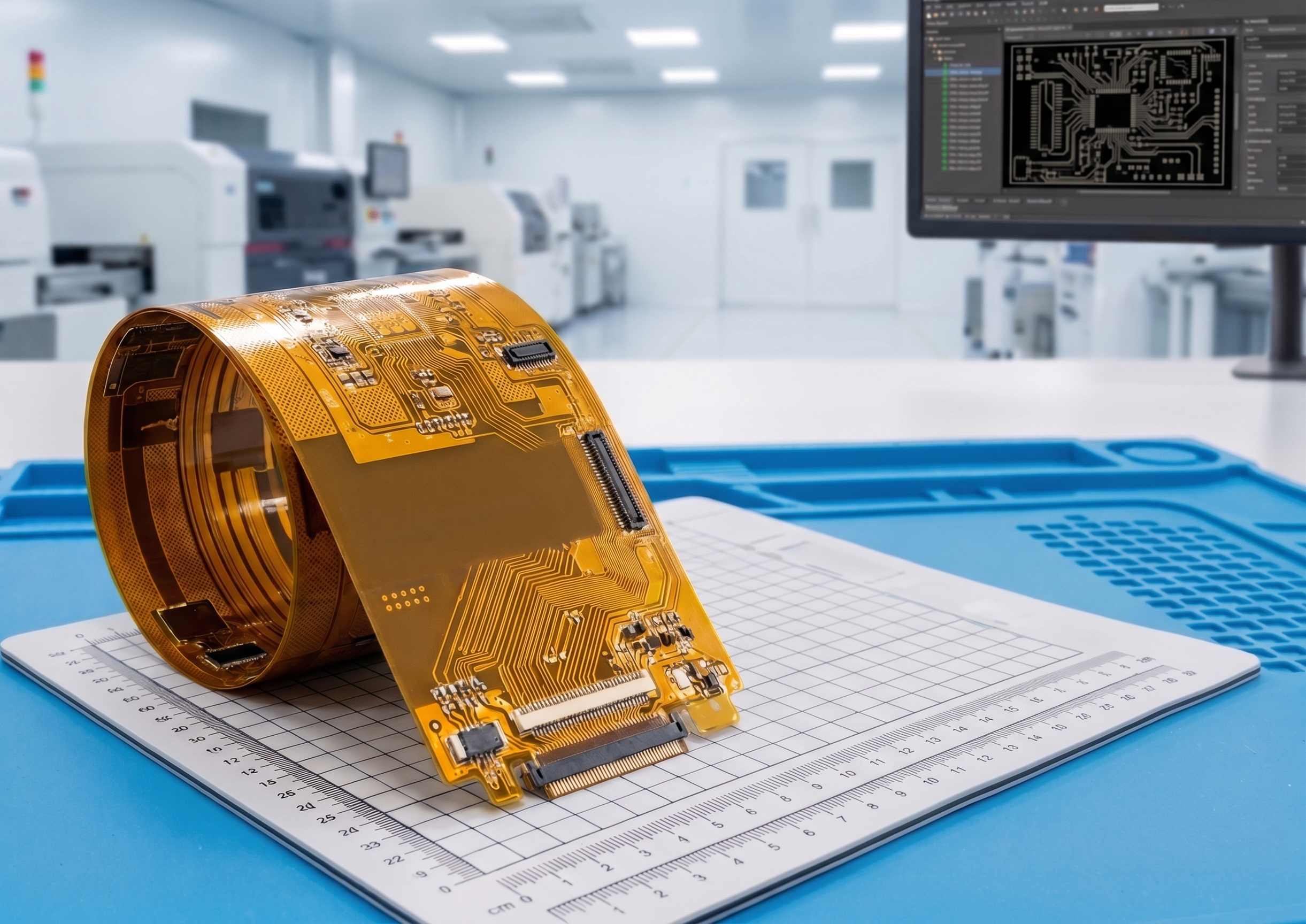
Pioneering Electronic Precision Manufacturing: Deep Dive into the Material Science, Structural Keys, and Future High-Frequency Applications of FPC Flexible Circuit Boards
In the ruthless modern hardware race toward extreme device miniaturization, smart wearables, and the rapid deployment of Edge AI computing nodes, the internal space optimization war has fully escalated into a micron-scale (µm) boundary battle. As devices continue to push past traditional thickness limitations, the FPC (Flexible Printed Circuit) has evolved from a passive connection accessory into a critical "Central Nervous System" that regulates overall product reliability and service lifecycles. Below, we break down the engineering horizons and manufacturing boundaries of FPC technology from the dual perspectives of materials science and advanced fabrication.
I. The Four Core Attributes of FPC: Driving a Spatial Revolution inside Dense Hardware Enclosures
The widespread replacement of legacy rigid boards (RPCBs) with flexible substrates across high-tier terminal systems stems from the unique physical and electrical performance advantages inherent to polymer film matrices:
-
Three-Dimensional Spatial Flexing (3D Flexibility)
(1) The defining asset of an FPC resides in its ability to bend, fold, roll, and twist across multi-axis tracks without introducing electrical impedance spikes or trace micro-fissures over long-term mechanical stress lifecycles.
(2) This grants hardware layout engineers total freedom to bypass flat, two-dimensional routing boundaries and execute complex non-linear spatial overlapping.
-
Extreme Low-Profile Compression and Weight Reduction
(1) Compared to standard rigid substrates, the absolute thickness and weight of a flexible circuit are heavily truncated. This functions as a vital passkey for space-constrained enclosures like flagship smartphones and True Wireless Stereo (TWS) earbuds, where maximizing internal battery capacity is a core goal.
-
Elite Fine Line and Space Routing Densities
(1) Utilizing high-precision chemical etching or laser processing—such as the Modified Semi-Additive Process (mSAP)—flexible circuits can achieve ultra-fine trace widths and pitches. This allows layout teams to crowd high-density connections into micro-scale sensor housings and small connector footprints.
-
Excellent Convective Thermal Exchange and High Temperature Resilience
(1) Because an FPC possesses an exceptional surface-area-to-volume ratio, the substrate accelerates heat dissipation, preventing localized thermal pockets from trapping heat inside sealed, unventilated enclosures.
(2) Furthermore, high-grade base materials survive the demanding 260ºC environments of lead-free reflow ovens, demonstrating superior environmental stress defense.
II. The Fundamental Microstructure of FPC: Decoding the Classical Three-Layer Laminate Process
The internal cross-section of a high-reliability, standard single-sided flexible circuit is synthesized by stacking three distinct material layers with specialized physical properties.
(I) Mechanical and Electrical Balancing Across Base Films, Copper Foils, and Coverlays
-
The Insulating Base Film Core
(1) Serving as the primary skeletal framework of the circuit, this layer standardly sources high-molecular-weight Polyimide (PI) films.
(2) It isolates the electrical routing, supplies uniform dielectric insulation, and anchors the physical flexibility of the circuit while preserving extreme thermal stability under manufacturing heat cycles.
-
The Conductive Copper Foil Layer
(1) Manages high-speed data bus signaling and current delivery loops. Based on processing parameters, this layer is classified into Rolled-Annealed (RA) Copper or Electrodeposited (ED) Copper.
(2) RA copper exhibits outstanding micro-crystalline lattice ductility and fatigue resilience, making it a mandatory baseline specification for components subjected to continuous, dynamic bending cycles (such as the hinge routing inside foldable displays). Conversely, ED copper offers a lower sourcing cost structure and handles static fine-line layouts beautifully.
-
The Protective Insulating Coverlay
(1) Functions identically to the solder mask applied to a rigid PCB, yet typically mirrors a thin polyimide film coated with high-adhesion resins.
(2) Its core engineering mandate is to seal the underlying copper traces completely, shielding the metallurgy from moisture ingress, electrochemical oxidation, and external mechanical scraping.
III. Four Dominant Vertical Markets: Scaling from Consumer Mobility to Rigorous Automotive Standards
By resolving the historical engineering trade-off between physical envelope compression and dynamic mechanical motion, the flexible circuit has become a mandatory component across four high-tier technology verticals:
(II) Massive MIMO Layouts, Wire-Harness Weight Reduction, and High-G Dynamics
- Flagship Consumer Mobility (Smartphones and Tablets)
(1) This remains the highest-volume vertical driving advanced FPC engineering.
(2) From high-density OLED display driver lines and multi-lens Compact Camera Modules (CCM) to lateral solid-state pressure buttons and high-speed battery tracking loops, a premium flagship smartphone routinely deploys 10 to 15 distinct flexible ribbons.
-
New Energy Automotive Telematics (EV Power Grids and Intelligent Cockpits)
(1) Driven by the ascent of electric vehicles (EVs), implementing an alternative sourcing system where FPCs replace heavy, space-wasting copper wire harnesses has emerged as a permanent design directive.
(2) Within critical Battery Management Systems (BMS), elongated large-scale FPC ribbons act as localized telemetry networks gathering cell-voltage data and tracking thermal fluctuations. This eliminates manual wire errors, trims vehicular mass to extend battery ranges, and enables 100% automated pick-and-place manufacturing.
-
Precision Biometric Instruments and High-Density Wearables
(1) Smartwatches, micro-scale digital hearing aids, disposable medical endoscopes, and implantable physiological sensors operate within ultra-stringent casing limits.
(2) The minimal mass of an FPC paired with strict bio-compatibility validation compliance certificates makes it the ideal interface for micro-display arrays and medical sensors.
-
Premium Foldable Computing Platforms and Articulated Sub-Assemblies
(1) Foldable computing displays and 2-in-1 gaming rigs subject their internal routing to tens of thousands of dynamic bending stresses along their mechanical hinge channels. This demands RA copper FPCs with strict impedance matching and extreme fatigue limits to prevent screen glitching or signal drops.
IV. Emerging Technology Boundaries: Confronting High-Frequency Demands in the 6G and Edge AI Era
As 5G-Advanced, upcoming 6G telecommunication standards, and localized Edge AI workloads push data throughput parameters exponentially higher, the flexible electronics sector faces strict new material science challenges:
(III) Substrate Metamorphosis and Millimeter-Wave Signal Integrity Optimization
- The Physical Limitations and Dielectric Blind Spots of Legacy PI Materials
(1) Traditional polyimide (PI) base films suffer from elevated dielectric constants (Dk) and dissipation factors (Df) when forced to operate within high-frequency bands (such as mmWave spans exceeding 28GHz).
(2) This poor performance turns valuable data signals into parasitic thermal dissipation, inducing transmission loss and thermal throttling bottlenecks that limit high-speed computing modules.
-
The Strategic Ascent of Advanced LCP and MPI Materials
(1) To preserve flawless signal integrity across ultra-wide data pipelines, high-tier flexible circuit substrates are migrating toward low-loss Modified PI (MPI) compounds and premium Liquid Crystal Polymer (LCP) laminates.
(2) LCP molecules exhibit near-zero moisture absorption paired with an exceptionally flat, low-loss high-frequency attenuation profile. Furthermore, the outer coverlay must be synchronized with equal low-loss polymers to ensure complete impedance matching across the entire routing channel, shielding every gigabit of digital transmission from signal reflections.
V. Professional Technical Q&A: High-Frequency FPC Fabrication and Sourcing Insights
Q1: During automated SMT mass production, how can manufacturing plants prevent thin FPC substrates from warping and triggering coplanarity errors across micro-scale terminal contacts?
A: Eliminating this manufacturing defect depends entirely on implementing high-stability SMT Carriers / Solder Jigs paired with strict coplanarity control. Because an FPC body lacks rigid mass, it is highly prone to warping under the extreme thermal stresses of a lead-free reflow profile. Before entering the paste printing and pick-and-place lines, the flexible substrate must be locked flat onto a high-rigidity magnetic or mechanical alignment carrier plate. This tool stabilizes the flex sheet, allowing the automation line to process it with the same positional accuracy as a rigid PCB, while thermal relief layouts on the traces ensure even heat distribution.
Q2: FPC boards are highly customized components. When building a dual-sourcing network, what engineering parameters must procurement teams verify during alternative part qualification?
A: When qualifying a drop-in replacement alternative for a custom FPC layout, verifying that the physical footprint matches pin-to-pin is merely the baseline step. Procurement and DFM engineers must carefully audit the vendor's grain orientation and dynamic flex lifecycle reports for the underlying rolled copper foil. If an alternative foundry fails to tightly control the micro-crystalline texture of its RA copper, the component will easily pass static bench-testing but will trigger catastrophic field fractures along the bending corridor after a few months of normal consumer use. Mandatory environmental reliability testing (thermal shock, dynamic cycling, and drop testing) remains an indispensable investment for supply chain risk mitigation.
VI. Conclusion
The modern flexible circuit board has evolved past the historical definition of a passive ribbon jumper; it operates as a core hardware asset dictating transmission stability across high-frequency 5G/6G buses and ensuring seamless processing across localized Edge AI devices. Supported by the maturation of mSAP precision trace lithography and the diversification of multi-source low-loss resin paths, FPC technology will continue to guide hardware architectures toward an invisible, highly intelligent, and ubiquitous future. In this global race toward lightweight computing, organizations that master material science boundaries and control micro-scale manufacturing tolerances will secure long-term market dominance.