
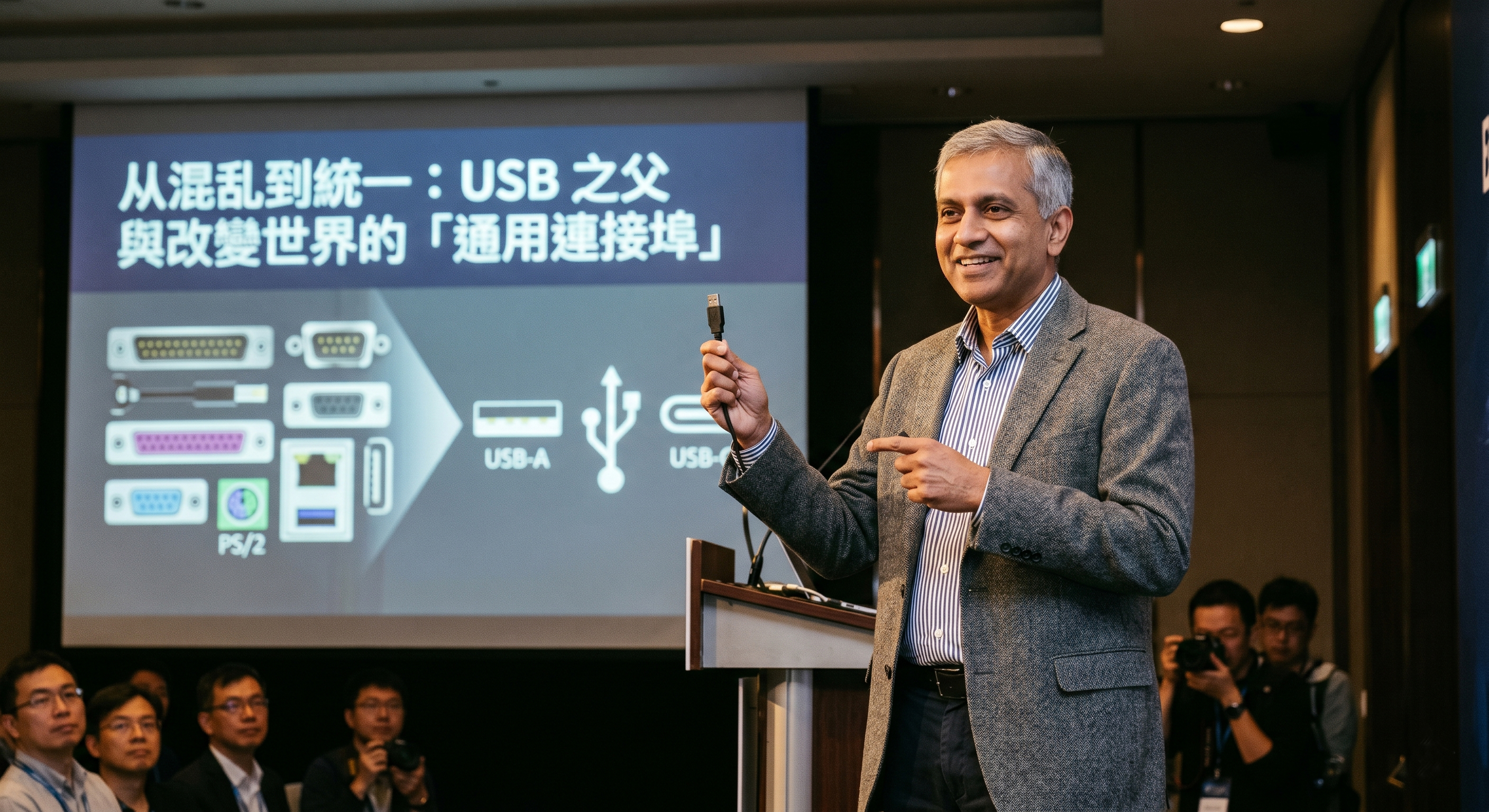
From Chaos to Consolidation: Analyzing the Father of USB and the History of the World-Changing "Universal Port"
In an era saturated by mobile computing and Internet of Things (IoT) ecosystems, modern users have long taken the USB (Universal Serial Bus) interface for granted. Whether executing high-speed charging protocols for a smartphone or streaming massive data blocks across parallel hardware, that miniature interface routes the interconnection of billions of devices globally. Yet, if we rewind the tech timeline 30 years, the input/output (I/O) interface layout on the rear of a personal computer chassis represented a state of absolute physical chaos for engineers and consumers alike.
I. Inspiration Born from Household Chore Frustrations: An Intel Engineer's Hardware Design Barriers
The genesis of USB technology did not stem from abstract academic theory inside a vacuum lab; it was triggered by a routine, highly mundane household assembly task. In the early 1990s, Ajay Bhatt—then serving as a senior system architecture engineer at Intel—was attempting to install a newly purchased desktop printer for his family PC.
(I) The Compatibility Blind Spots of the Pre-USB Era
- Convoluted, Non-Interchangeable Interface Standards
(1) During this historical window, legacy PC peripheral routing was incredibly fragmented: mice and keyboards relied on circular PS/2 ports, printers demanded bulky, high-pin-count parallel ports, and external modems required separate serial ports.
(2) Every connector featured distinct physical dimensions, pin counts, and electrical characteristics, rendering PCBA layout strategies increasingly messy.
- Exorbitant System Setup and Intermittent Configuration Pitfalls
(1) Integrating a new peripheral required opening the computer chassis manually to toggle mechanical jumpers, which frequently triggered severe Interrupt Request (IRQ) resource mapping conflicts.
(2) Devices could not be recognized dynamically; a full system reboot was mandatory following any hardware change. Surveying the non-interchangeable cables under his desk, Bhatt realized a core truth: if technology was to scale into everyday households, hardware mating must match the simplicity of an electrical wall outlet—achieving true "Plug and Play."
二、 The Convergence of Technology Titans: The Birth of the USB-IF Standard Association
While Bhatt formalized the universal port concept inside Intel, overturning an entrenched PC supply chain infrastructure was an impossible feat for a single enterprise working in isolation. Consequently, in 1994, Intel spearheaded a coalition alongside Microsoft, IBM, Compaq, NEC, DEC, and Nortel—uniting seven tech titans of the era to form the USB Implementers Forum (USB-IF).
(II) The Three Core Modernization Vectors Defined by USB-IF
- Radical Footprint Simplification: Replacing a messy array of traditional ports with a single, highly standardized hardware interface to reclaim valuable motherboard real estate.
- Integrating Hot Swapping Capabilities: Permitting peripheral insertion or removal while the host circuit remains fully powered, relying on low-level OS drivers to dynamically allocate system resources.
- Eliminating External Power Transformers: Routing baseline DC voltages and currents directly through dedicated internal power lines within the cable assembly, powering peripheral nodes without bulk wall adapters.
三、 Implementation Friction and Rapid Scaling: Tracking the Tech Evolution to USB Type-C
Although the baseline USB 1.0 specification debuted in 1996, early market adoption moved sluggishly as legacy foundries hesitated to alter their tooling. The inflection point arrived in 1998 when Apple unveiled the translucent iMac G3. By boldly eliminating all legacy proprietary ports and establishing USB as its exclusive I/O hub, Apple triggered an explosive, industry-wide scaling cycle across the global supply chain.
(III) Historical Technical Specifications Across USB Generations
As data loads scaled, the USB-IF continuously optimized Design for Manufacturability (DFM) metrics to push the boundaries of bandwidth and power delivery (PD):
|
Interface Generation |
Launch Year |
Max Data Signaling Rate |
Core Hardware Attributes & Structural Shifts |
|
USB 1.1 Standard |
1998 |
12 Mbps |
Rectified early timing bugs; propelled into the commercial mass market via the Apple iMac ecosystem. |
|
USB 2.0 High-Speed |
2000 |
480 Mbps |
Bandwidth experienced a massive leap; emerged as the global standard for flash drives and external media. |
|
USB 3.0 SuperSpeed |
2008 |
5 Gbps |
Pin count expanded to integrate full-duplex transmission paths; adopted blue polymer insulator cores for identification. |
|
USB Type-C Interface |
2014 |
10 Gbps – 40 Gbps+ |
Adopted a 24-pin symmetrical layout enabling reversible blind-mating; paired with Power Delivery (PD) protocols. |
四、 The Altruistic Royalty-Free Open Patent Strategy: Securing Global Interconnect Hegemony
Remarkably, despite being recognized globally as the "Father of USB," Ajay Bhatt did not extract a single cent in personal royalty fees from this revolutionary invention. While Intel held the core underlying patents governing the USB interface, executive leadership made a grand, forward-looking decision: they released the USB patent pool to the global market entirely free of licensing fees. This move aimed to maximize adoption velocity, dissolve cross-brand compatibility walls, and slash manufacturing entry barriers for third-party vendors.
Bhatt reflected during a subsequent technology panel: "As an engineer, seeing your baseline concept completely reshape global infrastructure and make complex computing accessible to everyday individuals while blending invisibly into the background of daily life is the ultimate reward and honor."
五、Professional Technical Q&A: USB Hardware Infrastructure Realities
Q1: How does the modern USB Type-C interface physically achieve its "Reversible Blind-Mating" capability?
A: This is managed via an ultra-precise, mirror-symmetrical 24-pin arrangement layout. Both the female receptacle and male plug incorporate mirror-image terminal tracks split across row A and row B (12 pins each, configured such that A1 mirrors B12 and A12 mirrors B1). Upon insertion, specialized Configuration Channel (CC) pins dynamically sense the orientation vector. The CC pins instruct the host controller multiplexer to swap the active electrical high-speed data paths in real time, resolving the old physical pain point of misaligned orientation.
Q2: "Currently, what is the greatest engineering challenge faced in PCBA layout design for high-speed USB4 interfaces?"
A: The chief bottleneck resides in maintaining strict Signal Integrity (SI) and suppressing aggressive Electromagnetic Interference (EMI). USB4 signaling cascades at 40 Gbps to 80 Gbps, meaning tiny geometric track mismatches or solder variances trigger massive signal attenuation. Layout engineers must apply rigorous impedance matching protocols, routing differential pairs with perfect trace-length equality encased in solid ground shielding. Furthermore, the board-side connectors must exhibit flawless coplanarity tolerances to prevent high-frequency radiation leakage from blinding adjacent 5G RF or Wi-Fi front-end modules.
VI. Conclusion
The 30-year evolutionary path of the USB standard serves as clear proof of a core concept: true technological progress in the hardware domain is not measured by how convoluted an architecture can be stacked. Rather, it is defined by how effectively standardization simplifies complex inter-device operations and power routing down to an invisible, completely intuitive act. From the tangled mess of printer adapters behind Ajay Bhatt's desk to the contemporary Type-C cable unifying display arrays, data streaming, and high-wattage power delivery, this universal journey has permanently rewritten the architecture of human technology.