
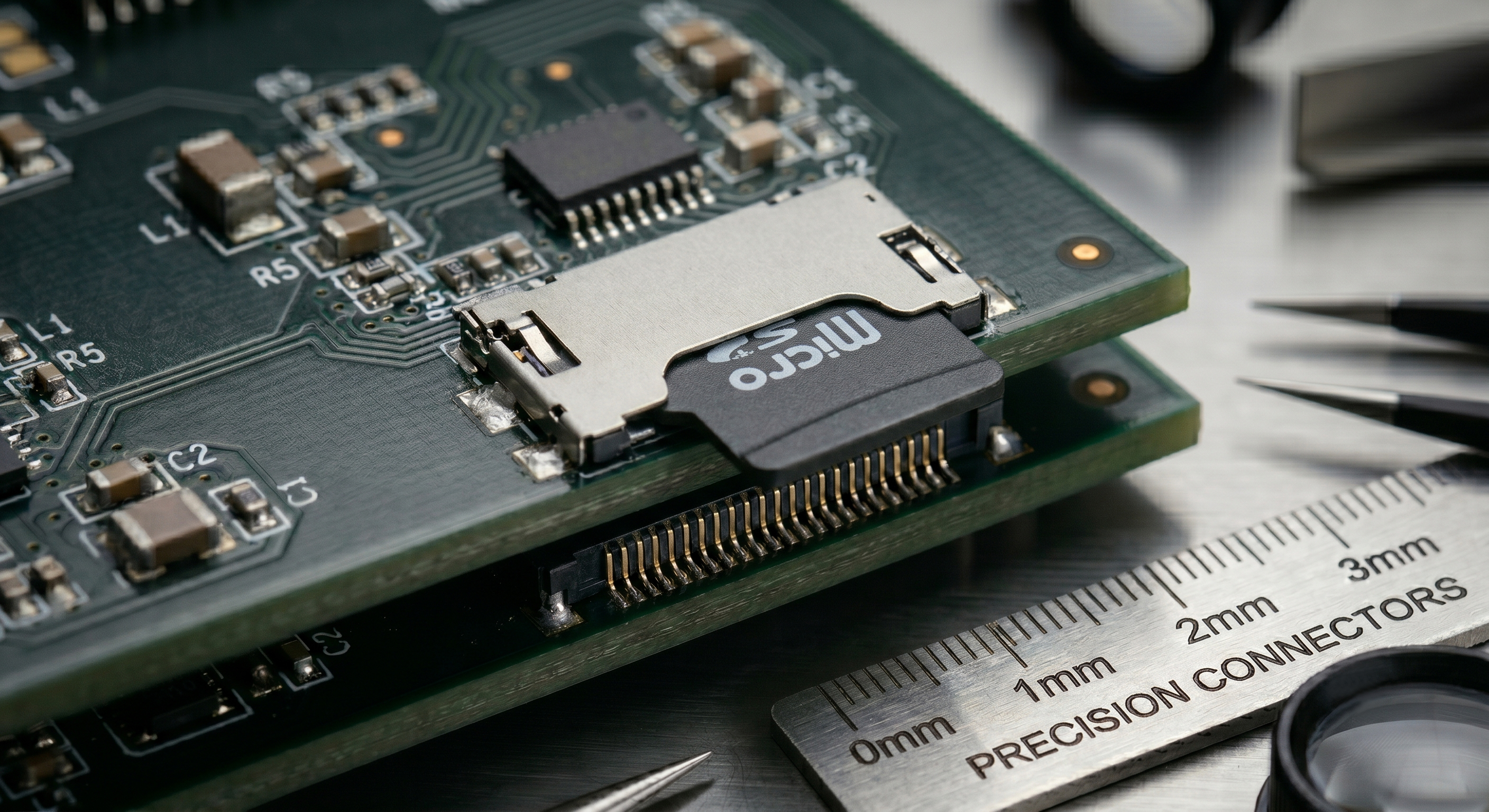
Extreme Challenges in Precision Engineering: Analyzing How Card Connectors Achieve Low-Profile Form Factors and Superior Field Reliability
Driven by the relentless consumer market pursuit of slim device aesthetics and compact form factors within smartphones, lifestyle wearables, and foldable smart displays, the internal real estate war inside electronic enclosures has escalated into a micron-scale (µm) boundary battle. Serving as the vital communication bridge linking external high-speed non-volatile storage (MicroSD) or cellular transceiver modules (SIM Cards) to the central processing unit, the Card Connector is confronting unprecedented engineering limits. Hardware designers must answer a punishing technical question: how can the absolute profile thickness of a card slot be compressed below 1.0mm while continuously safeguarding pristine electrical conduction under intense mechanical harmonics, unexpected drop impacts, or thousands of repeated insertion cycles? Below, we break down the definitive design parameters from the dual perspectives of advanced tool fabrication and contact materials mechanics.
I. Structural Innovation Under Spatial Constraints: Thin-Wall Molding and Insert Molding Overlays
To accommodate spring terminals, an insulating polymer housing, and a protective metallic chassis engineered for Electromagnetic Interference (EMI) Shielding within a vertical Z-axis clearance strictly under 1.0mm, hardware architects must completely overturn conventional sub-assembly logic.
(I) High-Flow Polymer Processing and Monolithic Contact Integration
- Advanced Thin-Wall Injection Molding
(1) Traditional polymer frames suffer from severe uneven shrinkage, short-shot filling voids, or thermal warping when their physical profiles are compressed past baseline safety margins.
(2) Modern precision card slots bypass this limitation during Design for Manufacturability (DFM) tracks by specifying high-flow, ultra-rigid Liquid Crystal Polymer (LCP) resins. This material enables tool designers to execute extreme wall thicknesses ranging from a mere 0.1mm to 0.15mm while ensuring the molded frame undergoes zero geometric warping when exposed to 260ºC lead-free reflow oven zones.
- Insert Molding Manufacturing Procedures
(1) Instead of relying on legacy post-mold manual component insertion, modern foundries utilize automated insert molding to stamp and overmold the precision metal terminals directly into the polymer substrate matrix.
(2) This manufacturing methodology eliminates internal parts-accumulation tolerance gaps while exponentially elevating the structural compressive rigidity of the micro-scale plastic frame.
II. The Core of Mechanical Reliability: Micro-Scale Contact Kinematics and Zero-Intermittency Geometry
In the realm of materials mechanics, extreme structural thinness and prolonged elastic fatigue life exist as structurally opposing physical variables. When a cantilever terminal is abruptly shortened and thinned to meet extreme Z-height restrictions, its capacity to apply continuous positive normal force and resist stress relaxation decays rapidly.
(II) Advanced Alloy Metallurgy and Redundant Mating Topologies
- Sourcing Premium High-Performance Copper Alloys
(1) To secure a stable, uniform normal force threshold within a heavily truncated deflection stroke, tier-1 engineering teams bypass standard phosphor bronze in favor of premium Beryllium Copper (BeCu) or next-generation high-conductivity Titanium Copper alloys.
(2) These specialized base metals command extraordinary yield strength metrics and excellent fatigue resilience, guaranteeing that the terminal spring maintains continuous compression against the card's gold fingers over thousands of lifecycles, locking down baseline contact resistance values.
- Implementing Dual-Contact Point Geometries
(1) To combat instantaneous signaling drops (intermittency) triggered by aggressive drop testing or high-frequency vibrational stress, advanced card slots integrate dual-contact point profiles along a single terminal channel.
(2) If one contact point shifts momentarily or suffers high impedance due to micron-scale dust ingress, the parallel redundant contact path instantly sustains electrical continuity, achieving total hardware-level Zero Intermittency.
III. Anti-Misinsertion and Structural Defenses: Precision Cam Tracks and Asymmetrical Constraints
The more a miniature device prioritizes a sleek form factor and dense integration, the less tolerance its internal infrastructure has for manual "insertion violence." Precision engineering implants multiple multi-tier safety parameters within the card slot geometry:
-
Precision Cam Track Anti-Eject Mechanisms
(1) Self-ejecting (Push-Push Type) configurations isolate a precision heart-shaped cam path and slider pin configuration within their lateral boundary.
(2) By fine-tuning the spring damping coefficient, the connector safely regulates the kinetic force and sliding velocity during card ejection, completely preventing the media card from flying out and being lost.
-
Asymmetrical Physical Polarization Constraints
(1) Utilizing deliberate geometric asymmetry across the plastic frame and outer metal shell creates a robust physical anti-misinsertion (Poka-Yoke) mechanism.
(2) This structural block ensures that if a user attempts to force the card in backwards, upside down, or at an unaligned angle, insertion is completely blocked—permanently shielding internal spring contacts from fatal buckling or short-circuit failures.
IV. Surface Treatment Metallurgy and SMT Automation Quality Controls
At micro-electronic scales, minor surface oxidation anomalies or faint soldering imperfections will rapidly escalate into catastrophic total-device field failures in the consumer market.
(III) Selective Precious Gold Plating and Extreme Coplanarity Limits
- Precision Selective Gold Plating Technology
(1) To balance low-loss conduction with manufacturing cost control, foundries execute dense, localized gold plating (ranging from 3µ and 5µ up to 15µ) exclusively over the active electrical contact zones, treating remaining leads with functional nickel plating. This optimization secures excellent corrosion and wear resistance while preserving BOM cost structures.
- Strict Terminal Coplanarity Control Boundaries
(1) To align perfectly with high-speed automated surface-mount technology (SMT) lines at EMS assembly plants, the coplanarity deviation across all board-side soldering leads must be tightly held under 0.08 mm .
(2) Any minute pin warping from progressive die stress triggers non-wetting or intermittent cold joints inside the reflow oven, pushing the structural tolerances of high-speed progressive stamping tooling to their absolute limits.
V. Professional Technical Q&A: Card Connector Selection and Supply Chain Insights
Q1: With the rapid proliferation of eSIM and iSIM tech inside 5G-Advanced/6G devices, will physical card connectors face total obsolescence?
A: No. While consumer smartphones are progressively migrating toward eSIM architectures, physical card slots remain entirely irreplaceable across Industrial IoT (IIoT), automotive telematics control units (T-Box systems), power grid monitoring sensors, and high-tier security data logs (via MicroSD encryption). Physical media cards deliver high-security hardware isolation, tool-free field diagnostic swap capabilities, and offline data logging value that cannot be corrupted via remote network hacking. Future card slot design trends point toward multi-slotted combo architectures and ruggedized overmolded variants rather than industry extinction.
Q2: How should an enterprise secure its card connector supply chain? What engineering pitfalls are most common when qualifying a drop-in replacement alternative?
A: Establishing a dual-sourcing strategy is a key methodology to optimize BOM margins. However, when qualifying a drop-in substitute, the most common engineering blind spot centers on minor dimension variances across the outer shell ground tabs (GND Anchors) matching the factory stencil aperture. Even if the primary signaling pins match pin-to-pin perfectly, slight differences in the geometry of the outer grounding anchors can cause uneven surface tension during SMT reflow. This triggers tombstoning defects or weak mechanical peel strength. Consequently, procurement and DFM engineers must mandate rigorous overlapping shell geometry audits alongside low-volume production trial runs.
VI. Conclusion
The evolution and refinement of the card connector stand as a clear architectural example of the engineering truth: "a miss is as good as a mile." Behind every 0.1 mm reduction in vertical thickness lies a massive, multi-disciplinary leap spanning advanced polymer chemistry, non-linear multi-axis stress modeling, and ultra-high-precision mold tool scaling. Within contemporary dense hardware frameworks, it operates far past the bounds of a passive telecom peripheral; it represents a specialized engineering triumph allowing highly integrated devices to achieve extreme computing stability within heavily restricted physical spaces.