
From Gray to Rainbow Ribbon Cables: Why "Red-Gray-Green" is the Ultimate Balance in Industrial Wiring
In the worlds of electronic circuitry, automated machinery, and industrial wiring, the evolution of ribbon cables (flat cables) is not a simple matter of "out with the old, in with the new." Instead, it represents a diversification driven by the practical needs of visual identification, error prevention (Poka-Yoke), and field installation efficiency. Many beginners and procurement professionals wonder: since standard "gray ribbon cables" and vibrant "rainbow cables" are already widely available, why does the "Red-Gray-Green ribbon cable" (also known as an intermittent color ribbon cable) still dominate high-end industrial equipment and PLC module interconnections? The answer lies in a hardware engineer's pursuit of precision, reduction of visual fatigue, and cost optimization.
I. Physical Characteristics and Trade-offs of the Three Main Industrial Ribbon Cables
Before exploring why the Red-Gray-Green ribbon cable is necessary, we must deeply analyze the specific engineering challenges its predecessors solved, along with their inherent limitations:
(I) Traditional Gray Ribbon Cable
- Structural and Visual Characteristics
(1) The entire cable body is uniformly gray, except for the very first conductor (Pin 1), which features a printed red or black edge stripe to indicate orientation.
- Core Engineering Pros and Cons
(1) Advantages: It utilizes the most mature manufacturing process and boasts the fastest production speeds. This results in incredibly low procurement costs and a neat, uniform appearance when routing large surface areas.
(2) Disadvantages: When dealing with high pin counts (such as 40P or 64P), the identical color of the inner conductors makes counting individual lines a severe visual challenge. If an open circuit or misalignment occurs in the middle, troubleshooting via visual inspection is nearly impossible.
(II) High-Visibility Rainbow Ribbon Cable
- Structural and Visual Characteristics
(1) Every adjacent conductor is extruded in a different color, typically following the international 10-color cycle standard sequence.
- Core Engineering Pros and Cons
(1) Advantages: Visual recognition is exceptionally high. The sequence number of each wire and its corresponding pin can be identified at a glance, minimizing wiring errors during manual soldering or individual wire jumping.
(2) Disadvantages: Multi-color co-extrusion carries the highest manufacturing cost. Furthermore, routing hundreds of multi-colored cables inside a single control cabinet creates visual clutter, making it difficult to trace overall cable bundle paths.
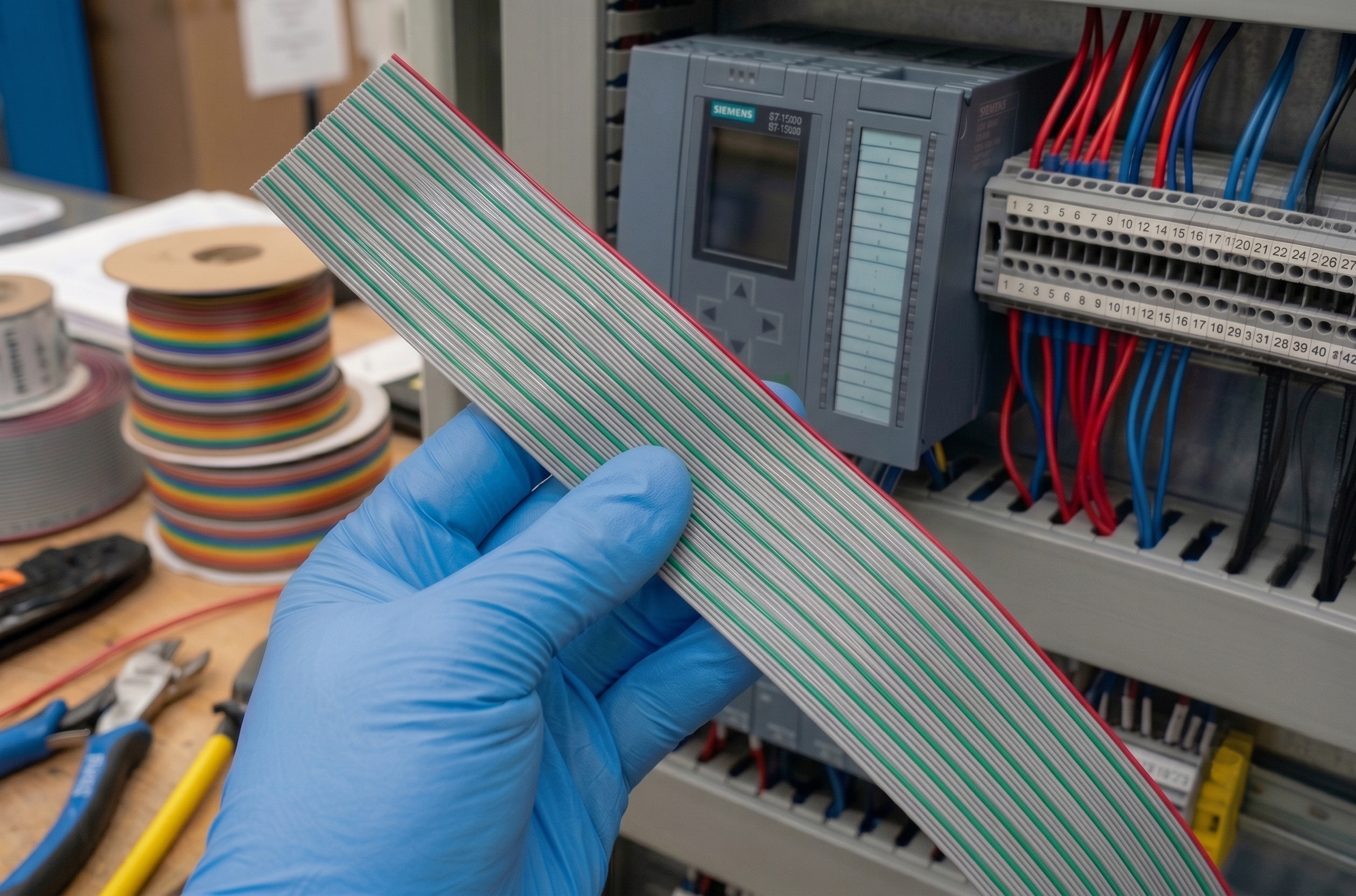
(III) Red-Gray-Green Ribbon Cable (Intermittent Color Ribbon Cable)
- Structural and Visual Characteristics
(1) The vast majority of the cable body remains a clean gray, but a specific red or green conductor is inserted at fixed intervals (e.g., every 10 pins).
- Core Engineering Pros and Cons
(1) Advantages: It represents the perfect engineering compromise. Without significantly driving up production costs, it provides technicians with distinct visual coordinates while maintaining a low-profile aesthetic and reducing eye strain.
(2) Disadvantages: When locating a specific pin that is not a multiple of the interval color, technicians still need to perform brief manual counting, lacking the immediate "one-to-one" intuition of a full rainbow cable.
II. Why the "Red-Gray-Green Ribbon Cable" is Essential in Industrial Control Systems
(I) A Visual Coordinate "Navigation System" for Error Proofing
When terminating or maintaining a high-density 40-Pin or 64-Pin gray ribbon cable, isolating Pin 23 from a dense wall of identical gray lines can be an absolute disaster for a technician's eyesight.
- Segmented Positioning Mechanism
(1) The Red-Gray-Green ribbon cable acts like the major tic marks on a precision ruler. Typically, the red wire denotes Pin 1 (the origin coordinate).
(2) Green wires are then placed precisely at positions like Pin 10, 20, 30, and 40. This allows maintenance personnel to instantly isolate the "target segment" during field modifications, drastically reducing the risk of a miscounted line causing a catastrophic system short-circuit upon power-up.
(II) The Golden Ratio of Bill of Materials (BOM) and Production Efficiency
- Manufacturing Process and Cost Control
(1) While rainbow cables are highly convenient, their co-extrusion process for multiple colored plastics is complex, and managing raw colorant inventories adds overhead. For mass-produced industrial equipment, a material price variance of even a few cents per meter directly impacts gross margins.
(2) The Red-Gray-Green ribbon cable retains the simple single-color extrusion process for the vast majority of its body, changing colorants only at specific nozzles. This satisfies quick-positioning requirements while keeping production costs significantly closer to standard gray cables.
(III) Mitigating Visual Fatigue and Enhancing Cabinet Ergonomics
- Avoiding Intense Color Distractions
(1) In large-scale automation control cabinets, routing hundreds of signal lines using vibrant rainbow colorways generates severe visual fatigue over time. It makes it difficult for troubleshooting personnel to evaluate overall cable bundle flow at a glance.
(2) The Red-Gray-Green ribbon cable uses neutral gray as its primary tone, preserving the professional, clean look of the electrical enclosure. It provides color cues only at critical reference nodes, perfectly balancing industrial aesthetics with functional utility.
III. Technical Comparison Matrix of Industrial Ribbon Cables
|
Ribbon Cable Type |
Primary Palette & Marking |
Production Cost |
Best-Fit Application Scenarios |
|
Standard Gray |
Uniform Gray + Pin 1 Red Stripe |
Lowest (Economical) |
Standardized, high-volume production equipment where wiring configurations are fixed. |
|
High-Visibility Rainbow |
Repeating 10-Color Cycle Sequence |
Highest (Premium) |
R&D prototyping, sampling stages, and projects requiring extensive manual split-wire soldering. |
|
Red-Gray-Green |
Gray Base + Intermittent Red/Green Lines |
Medium (Balanced) |
High-density, high-pin-count PLC signal architectures requiring frequent field maintenance. |
IV. Professional Component Selection and Design for Manufacturability (DFM) Insights
-
Prototyping and High-Maintenance Environments: If your hardware development project is in its infancy—requiring constant testing, manual cable splitting, or individual wire re-routing—the high-visibility rainbow ribbon cable is the ideal choice to save valuable diagnostic time.
-
Standardized Mass Assembly Lines: For standard control cabinet assembly where field technician lookup efficiency and aesthetic cleanliness must coexist, the Red-Gray-Green ribbon cable serves as the optimal partner to secure both manufacturing yield and product margins.
-
Alignment with IDC Polarization: Regardless of the cable type selected, when performing automated crimping, ensure that Pin 1 of the cable (indicated by the red wire or stripe) aligns perfectly with Pin 1 of the box or ejector header to fully realize the system's polarity keying benefits.
V. Professional Technical Q&A: Field Applications of Ribbon Cables
Q1: Does terminating Red-Gray-Green ribbon cables onto IDC sockets require specialized crimping tooling?
A: No. The wire pitch (such as the highly standard 1.27mm pitch used to mate with 2.54mm pitch board headers) and physical tolerances of Red-Gray-Green cables are identical to standard gray cables. Consequently, production lines can utilize existing IDC crimping machines and universal dies, keeping manufacturing transition costs at zero.
Q2: Why do some intermittent ribbon cables feature green wires every 9 pins instead of 10?
A: This variance depends entirely on the design framework of different wire manufacturers. Some manufacturers place a green wire after "every 10 gray wires" (making the green wire Pin 11), while others count the green wire as the 10th position. When writing standard operating procedures (SOPs) for assembly lines, always cross-reference the exact pin-out definition in the supplier's datasheet.
Q3: Does the color extrusion of a ribbon cable affect its signal integrity at high frequencies?
A: The color itself is determined by pigments mixed into the PVC insulation and has no direct impact on electrical performance. However, if a ribbon cable must carry high-frequency data, engineers should opt for specialized versions with integrated shielding layers, or adopt a "Signal-Ground-Signal (S-G-S)" pinout configuration to suppress adjacent-line crosstalk.
VI. Conclusion
Why does the market demand Red-Gray-Green cables when solid colors and full rainbow schemes already exist? It is an elegant case study in the evolution of industrial error-proofing and manufacturing economics: gray cables solved basic electrical connectivity; rainbow cables solved absolute pin-to-pin identification; and Red-Gray-Green cables perfectly resolved the real-world challenge of fast positioning within dense pin layouts at an optimized cost. It foregoes superficial flair to help technicians complete precise wiring operations in the shortest time possible, with the lowest possible cognitive load.