
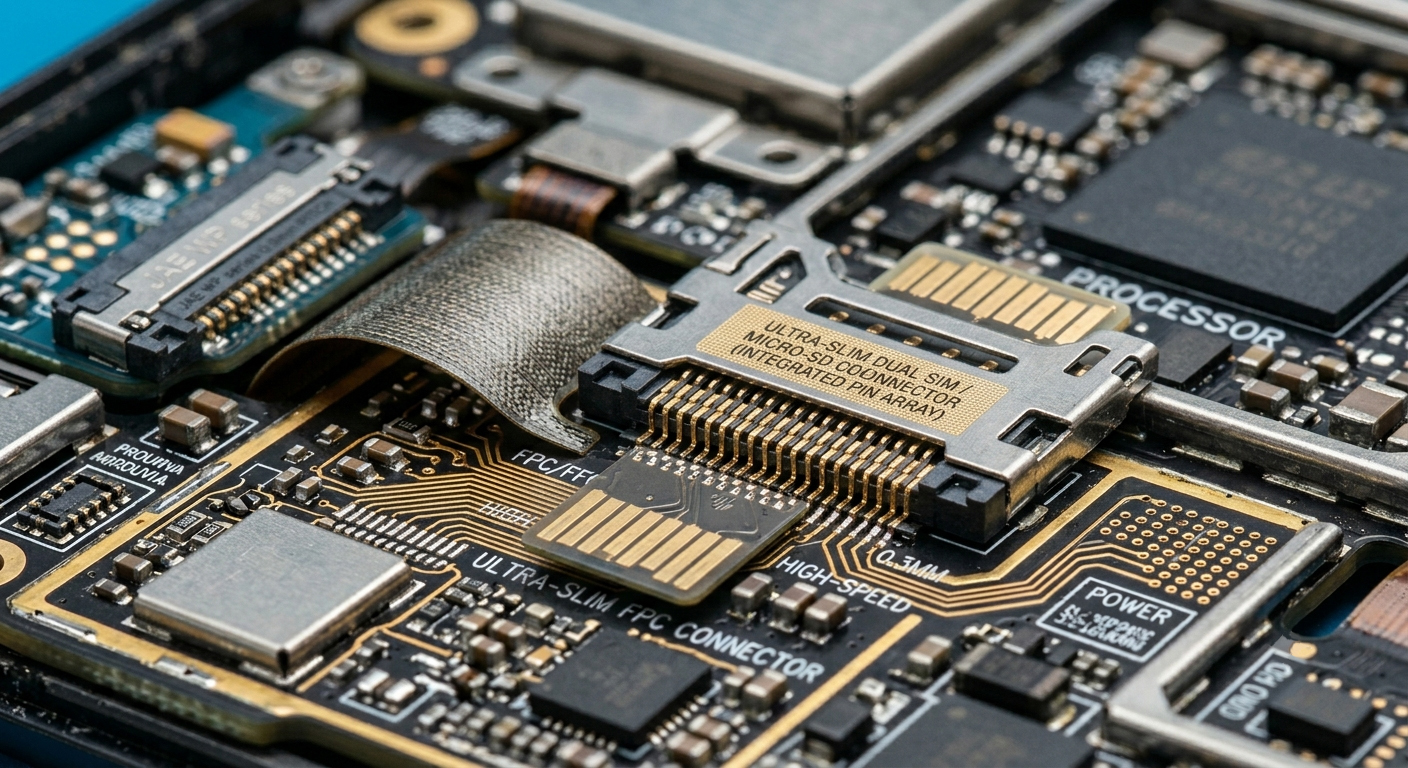
Anchoring Industrial and Automotive Precision Interconnects: Decoding the Decisive Role and Severe Environmental Technical Challenges of CARD Connectors
Driven by the global consumer push for extreme device low-profiles and the migration of mobile telematics toward eSIM or iSIM architectures, non-technical observers might assume that the era of physical card slots is coming to an end. However, within industrial automation, automotive electronics, the Intelligent Internet of Things (IIoT), high-tier medical equipment, and heavily fortified security surveillance networks, the role of CARD connectors (encompassing MicroSD slots, SIM card slots, and Smart Card readers) has not degraded. Instead, it has established itself as an absolute, non-substitutable baseline specification for securing peak system availability, edge data redundancy, and hardware-level information security. This analysis explores the core value propositions and manufacturing mechanics of advanced card connector interfaces.
I. Under the Industrial and Digital Waves: The Four Core Strategic Values of CARD Connectors
At its physical foundation, a card connector serves as the dedicated electrical interface enabling data exchange and security authentication with standalone external media. Within commercial and industrial hardware topologies, it operates as an irreplaceable bridge:
-
Hardware-Level Encryption and Physical Security Enforcement
(1) Within financial POS terminals, clinical smart-card readers, and classified government telecommunications infrastructure, data protection demands the highest safeguards.
(2) Utilizing precision card connectors to read physical smart cards or secured flash media (such as encrypted MicroSD cards) executes a two-factor cryptographic verification at the silicon layer, establishing a physically disconnected perimeter that remote network hackers cannot exploit.
-
Critical Edge Data Redundancy and Break-and-Resume Storage Operations
(1) For intelligent traffic intersection cameras (IP Cams) or industrial computers (IPCs) on automated assembly lines, unconditioned outdoor exposure can disrupt cloud connectivity. When network drops occur, the industrial-grade memory card nested inside the card connector instantly logs the active telemetry data.
(2) This firmware-managed "break-and-resume" protocol ensures that vital edge sensor readings and historical logs remain completely preserved, safeguarding Signal Integrity.
-
Global Telematics Agility Across Cross-Border Supply Chain Fleets
(1) While eSIM structures are standard in consumer mobility, physical SIM card slots remain the premier choice for cross-border logistics tracking units and global asset locators.
(2) It empowers operators to manually hot-swap physical SIM cards in the field to match varying national telecom tariff bands, keeping cellular data routing costs highly optimized.
-
Air-Gapped Field Maintenance and Localized Firmware Deployment
(1) In highly secure, air-gapped industrial processing plants or heavy machinery zones, assets lack external internet connectivity, blocking Over-the-Air (OTA) remote updates.
(2) Sourcing a dedicated memory card slot lets field technicians insert localized media to execute secure firmware upgrades or extract historical fault logs, presenting the fastest, safest, and most intuitive manual maintenance track.
II. Confronting Harsh Physical Environments: Four Technical Imperatives for Industrial and Automotive Topologies
Unlike commodity consumer gadgets, industrial and automotive-grade card connectors must sustain continuous operation over decades under extreme temperature swings and unrelenting mechanical shock waves. During the New Product Introduction (NPI) phase and early layout component selection, engineers must conquer several severe processing challenges:
(I) Anti-Vibrational Geometries, LCP Distortion Controls, and Plating Limits
- Mechanical Infrastructure: Resisting Continuous Vibrations and Sudden High-G Impacts
(1) Telematics sub-assemblies (such as dashcams, electronic logging devices, and T-Box modules) encounter persistent low-frequency road harmonics alongside severe sudden impact shocks.
(2) To prevent media card displacement from causing read/write open circuits, Design for Manufacturability (DFM) pathways discard standard self-ejecting (Push-Push) locking styles in favor of Hinged/Flip-Lock or high-damping Push-Pull profiles to keep the spring contacts continuously seated against the card pads.
- Advanced Material Science: Controlling Micron-Scale Polymer Warping During SMT Reflow
(1) On the automated assembly floor, card connectors operate as Surface Mount Devices (SMDs) that must traverse lead-free high-temperature reflow profile zones.
(2) To block micron-scale structural warping under thermal stress, the connector frame must source premium, high-flow Liquid Crystal Polymer (LCP) resins. Any housing distortion alters the terminal coplanarity control (≤0.08mm deviation boundaries) or permanently jams the internal mechanical slider tracks.
- Metallurgical Balancing: Minimal Contact Resistance via Heavy Gold Overlays
(1) Industrial environments frequently subject components to harsh humidity, salt-fogs, or corrosive airborne chemicals. If the copper alloy base metal of the internal terminal contacts undergoes atmospheric oxidation, baseline contact resistance values spike, destroying signal integrity.
(2) Consequently, industrial-tier card slots specify heavy selective gold plating layers measuring 15µ to 30µ exclusively over the active contact mating zones to lock in elite anti-corrosion properties over tens of thousands of insertion lifecycles.
- Intelligent Hardware Defenses: Integrating Dedicated Card Detection Switches
(1) High-end card connectors integrate an internal micro-scale Card Detection (CD) pin loop. The CD switch closes and transmits an interrupt command to the host MCU or CPU only when the media card is fully seated and locked by the internal housing geometry.
(2) This prevents the system from routing current to the terminal pads while a card is misaligned or half-inserted, eliminating localized electrical arcs, voltage surges, and short circuits that burn out both the memory media and the connector housing.
III. Professional Technical Q&A: Card Connector Footprints and PCBA Layout Realities
Q1: When mapping out a PCB layout, how should engineers fortify the anchoring pads of a card connector to absorb the high leverage forces applied by technicians during flip-lock actuation or manual insertion?
A: This processing failure traces back to mechanical stress inducing PCB landing pad delamination. Whether applying a hinged flip-lock or a high-tension push-pull slot, closing the cover or ejecting a card concentrates high torque forces across the housing's anchoring tabs. When configuring the PCB footprint, layout teams must avoid treating the grounding tabs as isolated surface pads. These anchors must use large-scale through-hole slotted geometries or link directly to massive internal ground copper planes (GND Planes). Furthermore, configure the stencil apertures to build up heavy solder fillets around these anchors, shifting the mechanical strains entirely into the board structure and shielding the fragile internal signaling leads from fracture defects.
Q2: How can hardware teams protect industrial-grade card interfaces against the long-term degradation caused by "Fretting Corrosion"?
A: Fretting corrosion is triggered by low-amplitude, high-frequency external mechanical vibrations that induce micro-scale relative slipping between the card's gold fingers and the connector terminal interfaces. This continuous micro-wiping action scrapes away noble metal coats; once the underlying base copper alloy is exposed, it oxidizes rapidly in ambient air. Beyond specifying a heavy 30µ gold coat over the contact zone, the mechanical chassis design must deploy integrated pressure foams or rigid structural ribs within the outer enclosure. This locks down the physical boundary conditions, shrinking the relative motion between the media card and the slot to absolute minimums to eliminate fretting risks.
IV. Conclusion: Precision Engineering Inside Micro-Scale Dimensions
Though hidden within the deep layers of a multi-layer PCBA and protected by external device shells, the card connector operates as a critical asset stabilizing the field reliability, communication agility, and physical information security of enterprise industrial complexes. From the thermal distortion boundaries of LCP frames to the micro-mechanics and thick noble metal plating of Beryllium Copper springs, every single micron-scale tolerance dictates the survival rate of end-user equipment in harsh fields. As international technology paths scale toward automated logistics networks, vehicle telematics, and Edge AI connections, choosing a card connector backed by strict manufacturing validation and ruggedized environmental certification remains the ultimate foundation for securing long-term system integrity.