
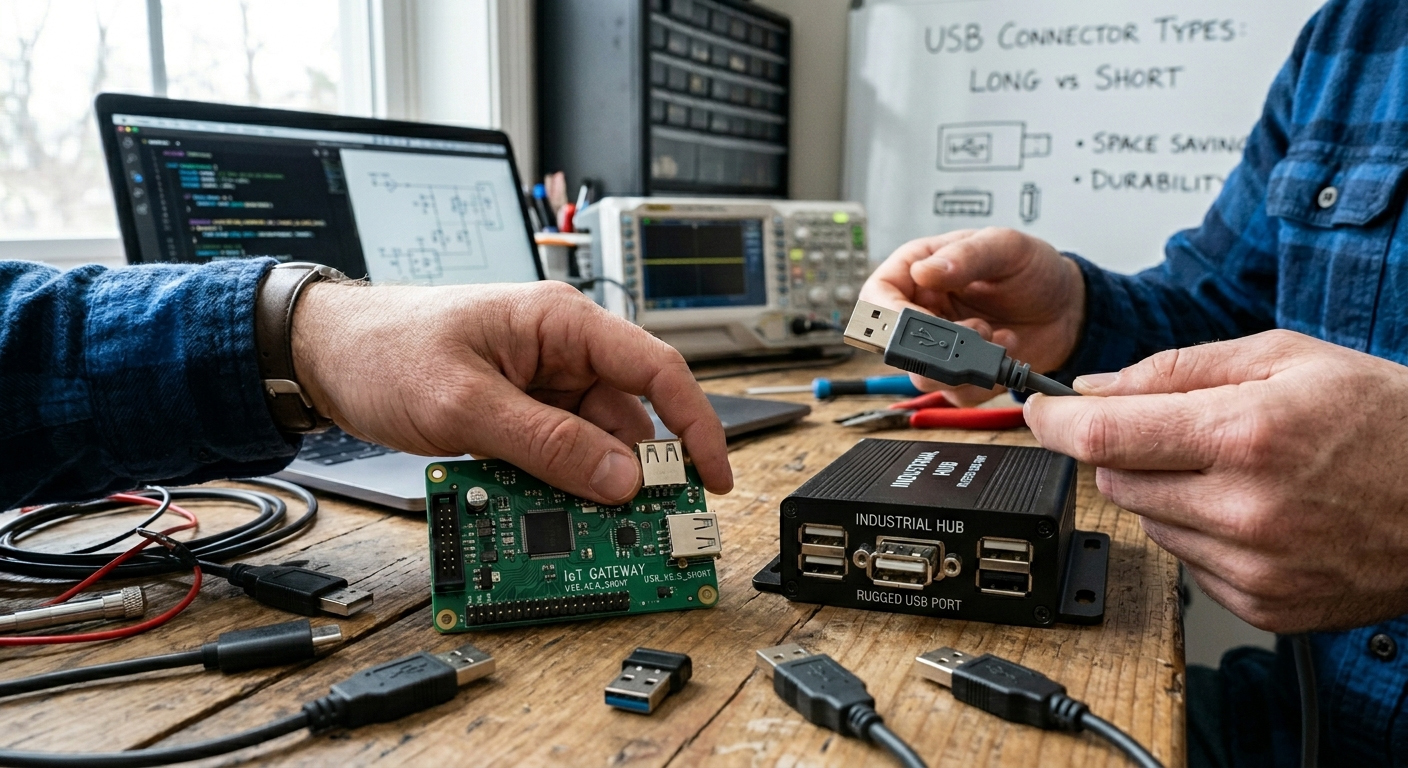
The Tug-of-War Between Space and Durability: Why USB Connectors Offer Long vs. Short Bodies?
In the intricate world of electronic components, the USB Type-A female connector—though standardized in its interface—actually comes in two distinct footprints on the PCB: Long Body and Short Body. While both allow your thumb drive to plug in smoothly, they represent fundamentally different engineering trade-offs in product design logic.
1. Space Management: The High-Stakes Battle for PCB Real Estate
The birth of the "Short Body" connector is a direct response to the trend toward ultra-thin mobile devices. In modern thin-and-light laptops, tablets, or compact power banks, the internal depth (Z-axis) of the chassis is extremely limited.
-
Depth Optimization: Short body specifications (typically around 10mm in depth) drastically reduce the longitudinal footprint on the PCB. This allows hardware engineers to reclaim valuable space for larger battery cells or to shrink the overall device dimensions.
-
Layout Flexibility: A shorter body helps avoid interference with other components on the rear of the PCB and optimizes airflow channels for thermal management.
2. Structural Integrity: Strength as a Guarantee of Longevity
Conversely, the "Long Body" connector (standardized at roughly 14mm or more) occupies more space but offers superior mechanical stability and EMI shielding.
-
Lever Principles and Stress Distribution: When a user frequently plugs/unplugs or accidentally tugs on a cable, the connector experiences significant torque. The long body design utilizes a longer structural lever, which distributes mating forces more evenly across the soldering tabs.
-
Solder Joint Reliability: Long body connectors usually have soldering tabs spaced further apart with larger contact surfaces. Over long-term use, this effectively prevents "solder fatigue" or cracks, significantly reducing the risk of component detachment under heavy use.
-
Enhanced Shielding (EMI): The extended metal shell provides more complete electromagnetic shielding, which is beneficial for signal integrity in high-speed data environments.
3. Application Comparison: Which One Should You Choose?
|
Feature |
Short Body |
Long Body |
|
Typical Depth |
~10.0mm to 12.0mm |
~14.0mm to 15.0mm |
|
Design Core |
Slimness & Space Saving |
Reliability & Structural Reinforcement |
|
Mechanical Life |
Ideal for static or light-duty use |
Ideal for high-mating cycle environments |
|
Common Use |
Ultrabooks, Wearables, Dongles |
Desktop Motherboards, Industrial IPCs, TVs |
4. The Designer’s Compromise: Hidden Engineering Factors
Choosing between a long or short body is essentially a trade-off between "Mechanical Strength" and "Volumetric Efficiency."
-
Manufacturing Compatibility: On SMT assembly lines, long body connectors often have a more stable center of gravity, which can improve pick-and-place yields during automated production.
-
Material Precision: While material costs are similar, short body connectors often require higher-density LCP plastics and high-precision stamping to maintain strength in a smaller frame, which can sometimes lead to a higher unit price than standard long versions.
Final Word:
When selecting a USB connector, don't just look at the interface type. Understanding the physical stakes behind the "Long vs. Short" body debate is crucial. While the long body offers rugged durability, the short body provides the flexibility needed for cutting-edge designs. Confirming your chassis clearance and expected mating cycles is the true key to selecting the right specification.